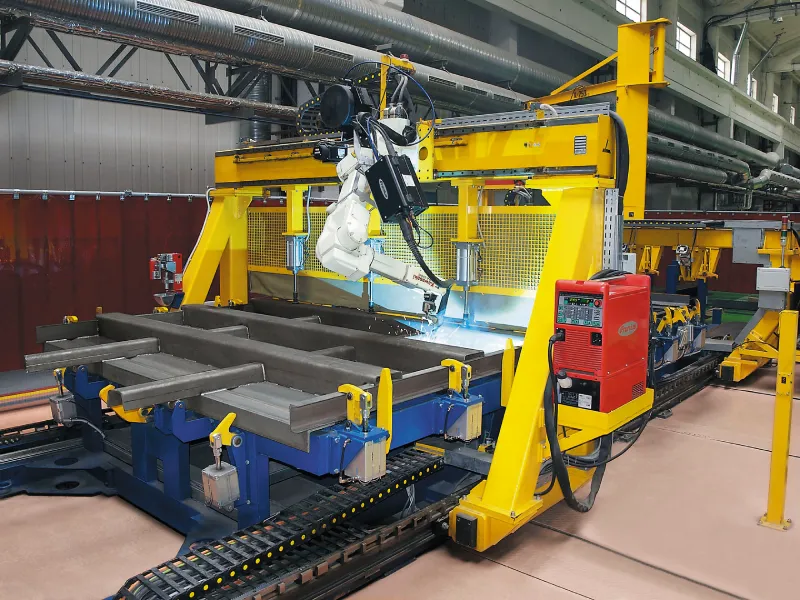
Modern railcar manufacturing places ever higher demands on throughput, weld quality, assembly accuracy and process stability. At the same time, building rolling stock involves a large number of operations that require high repeatability and significant labor input. A robotic welding cell on a railcar manufacturing shop floor.
Contents
- Why automation matters for railcar manufacturing
- Which railcar manufacturing processes can be robotized
- Robotic welding cells
- Automating center sill production
- Automating drilling of center sills and underframes
- Robotizing side and end wall production
- Automating railcar assembly
- Automating the handling of large structures
- Automated storage for steel stock and components
- Automating positioning and turning
- Automating shot blasting
- Robotic shot blast cleaning of railcars
- Robotizing railcar painting
- Automated quality control
- Integrating equipment into digital production
- What robotics delivers for a railcar plant
- When robotics actually pays off
- Where to start with robotics at a railcar plant
- A systems approach to automation
- Robotics as part of modernizing railcar production
- An engineering approach to robotics
- FAQ
One of the key directions in the industry today is automation and robotics in railcar manufacturing.
Robotic welding cells, automated assembly lines, positioners, turning fixtures, transport systems, automated geometry control and the integration of equipment into a single digital production system all make it possible to move from isolated mechanized operations to comprehensive production automation. For ready-made equipment, see the product catalog and the turnkey projects page.
Why automation matters for railcar manufacturing
Building freight and passenger railcars involves dozens of process steps — from preparing and processing sheet and profile metal, to assembling frames and bodies, fabricating side and end walls, roofs, center sills and bolster beams, welding metal structures, dressing welds, shot blasting, painting, checking geometry, moving large structures, and fitting units and assemblies. Many of these operations are still done manually or on general-purpose equipment.
As output volumes grow, however, manual labor becomes one of the factors limiting throughput. The result of a manual operation can also depend heavily on the skill of the individual worker involved.
Automation makes the process more stable and controllable, while robotics specifically automates repetitive operations that demand high precision and repeatability.
Which railcar manufacturing processes can be robotized
Robotization does not mean converting an entire plant to fully unmanned production. In practice, the most effective approach is to roll out automation step by step, area by area.
1. Robotic welding
Welding is one of the most promising areas for robotics in railcar production. Robotic welding cells can be used to fabricate side and end walls, roofs, frames, center sills, body components, bogie parts, and a wide range of other welded structures.
A robot moves the welding tool along a programmed path with consistent repeatability. With a properly engineered process, this makes weld quality more repeatable and reduces the influence of human factors. Depending on the part and the process, different welding methods may be used, including MIG/MAG, TIG, resistance welding and submerged arc welding (SAW).
Robotics pays off best where a plant produces long runs of identical parts.
Robotic welding cells
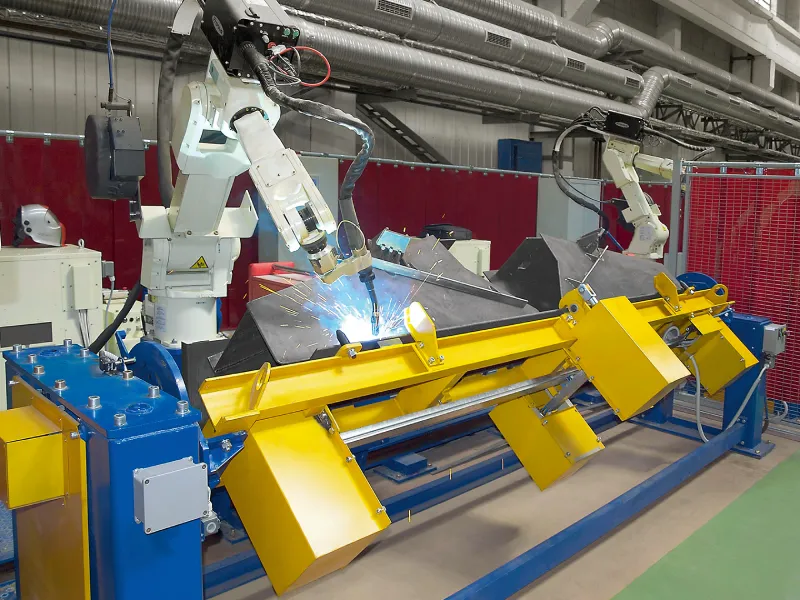
A modern robotic welding cell is more than just an industrial robot. The system typically brings together the robot itself, a welding power source and torch, a positioner or turntable, fixturing to locate the part, a wire feed system, sensors, safety guarding, a control system, a fume extraction system, and software.A positioner holds the part in the optimal orientation relative to the welding torch
Depending on the task, a cell may have several axes of motion and different ways of positioning the part. For example, a robot may work together with a two-axis positioner, a turning fixture, or a dedicated stand that keeps the part in the optimal orientation relative to the torch. Ready-made equipment of this kind is available in the catalog.
This is why robotic welding should be treated as a complete engineering solution, not simply a robot swapped in for a welder.
Automating center sill production
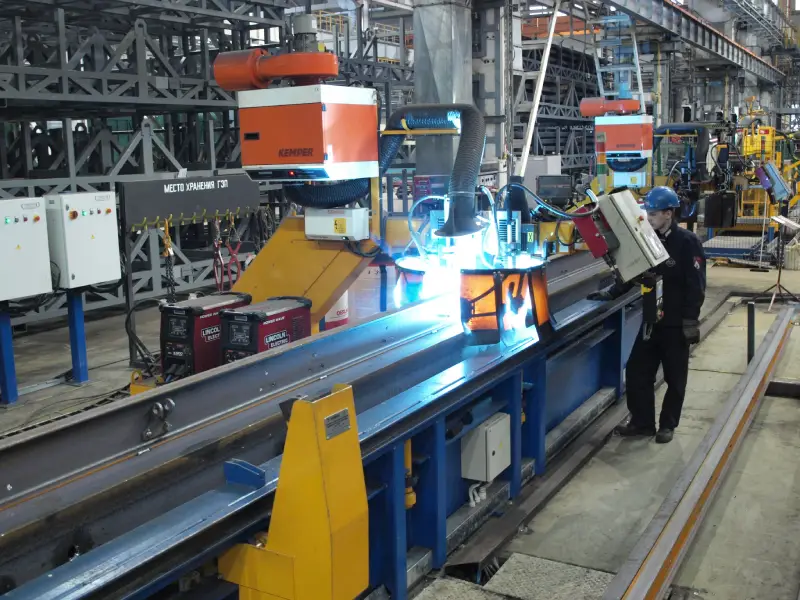
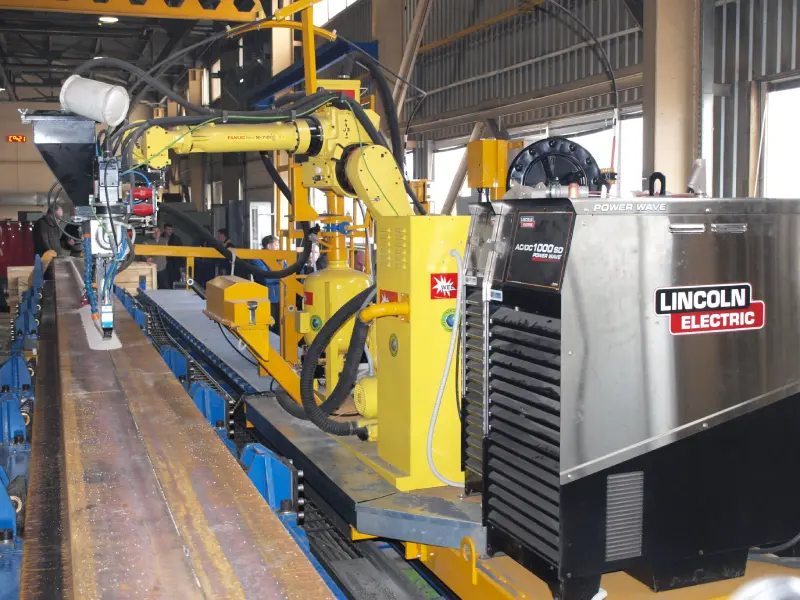
One good example of effective automation is center sill production for freight cars. These parts are long and heavy, and making them involves assembling, positioning and welding several elements together.
An automated cell can handle component loading, locating the elements, clamping the structure, tack welding, final welding, moving the part between stations, and monitoring process parameters — all in sequence. For long parts, keeping the part and the welding equipment moving in sync is especially important.
Submerged arc welding can deliver high productivity while maintaining consistent quality along long weld seams.
Automating drilling of center sills and underframes
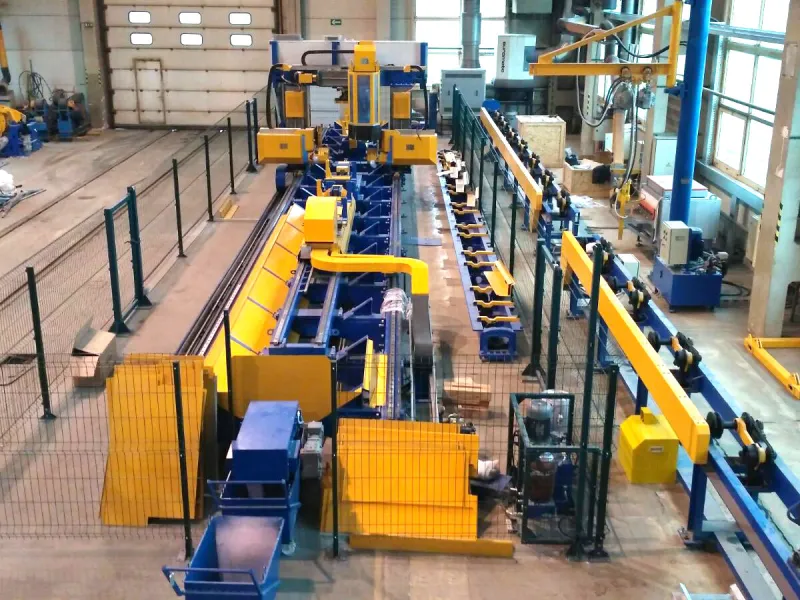
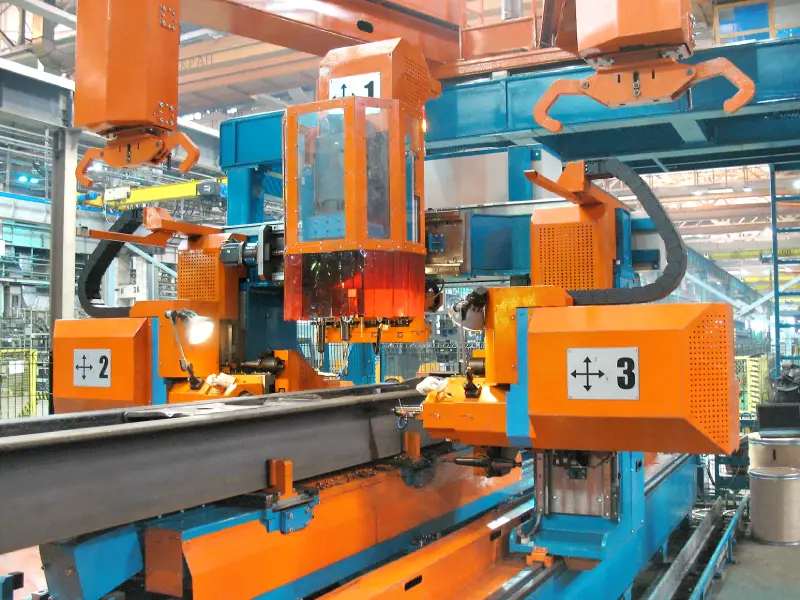
Beyond assembly and welding, the machining of center sills and underframe structures deserves its own attention — specifically, drilling the holes for center plates, side bearers, brake system brackets, and the mounting points for running-gear components. This is traditionally done on general-purpose drilling machines with manual layout and repeated repositioning of the part, which makes it one of the most labor-intensive steps on the entire production route and one of the most sensitive to human error.
Automated drilling relies on CNC machines that take hole coordinates directly from the part’s digital model and machine it without manual layout. For long parts such as center sills, gantry-type or multi-spindle drilling systems are used, with the workpiece automatically positioned along the machining axis — the part is clamped once, and the coordinate reference for every hole is maintained along the full length of the beam.
This approach brings several practical benefits. First, it removes the cumulative layout error that is typical of manually drilling a series of holes over a long distance. Second, cycle time drops because intermediate measuring and repositioning steps are eliminated. Third, hole placement becomes repeatable from part to part — which matters a great deal once the frame or beam moves on to robotic assembly and welding, where the accuracy of the reference holes directly affects the accuracy of everything assembled afterward.
Integrating the CNC drilling system into the plant’s broader production flow also makes it possible to load the machining program automatically whenever the part number changes, and to feed data on completed operations back into the production system — the same way robotic welding cells already do.
Robotizing side and end wall production
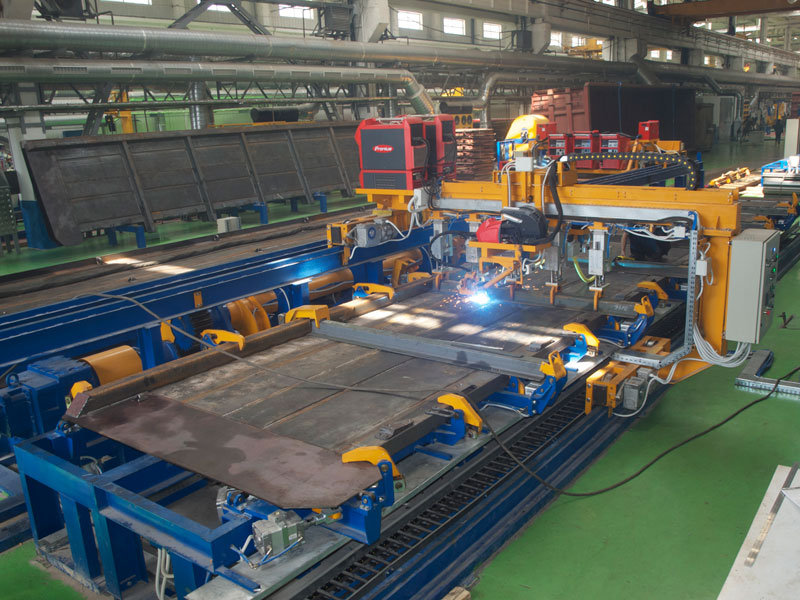
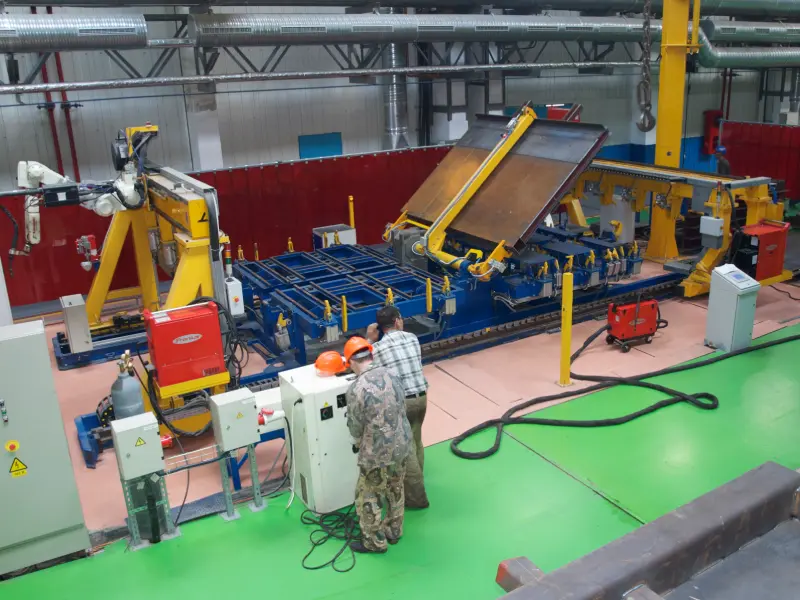
Railcar side and end walls are complex welded structures with a large number of repeating joints. Depending on the part design, a robotic cell can handle positioning the components, welding longitudinal and transverse seams, welding stiffening elements and frames, moving the part between stations, and repeating the welding operations consistently.
Tooling matters a great deal for this kind of work: it has to locate the parts precisely and minimize distortion during welding. That is why designing a robotic cell means engineering the robot, the welding process, part positioning and the tooling all together, not one after another.
Automating railcar assembly
Robotics is not limited to welding alone. Looking ahead, individual body assembly operations are also being automated: feeding components, positioning parts, installing elements, clamping, moving parts between workstations, automated welding, and checking part position.
Automated transport systems play a particularly important role here. A large railcar body cannot be moved efficiently between operations with ordinary shop-floor equipment, so automated production relies on dedicated transfer tables, transport platforms, lifting equipment, turning fixtures, car movers, turntables and positioning systems.
Automating the handling of large structures
In railcar manufacturing, a significant share of production time can go not to processing the part itself but to moving and positioning it. A car body, for instance, has to be lifted, moved, turned, set down at the next process station, and aligned precisely with the equipment there. Specialized transfer systems and material-handling equipment are used for exactly this purpose.A transfer table moves railcars between parallel tracks on the shop floor.
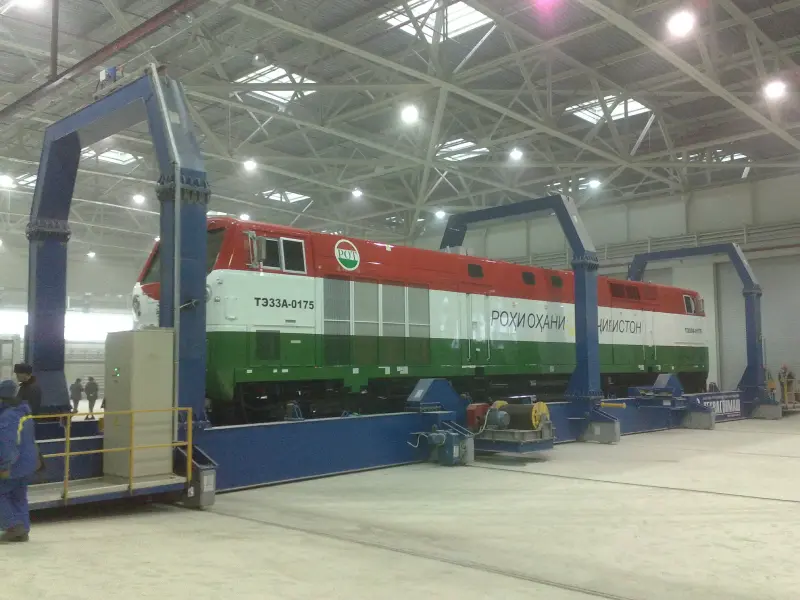
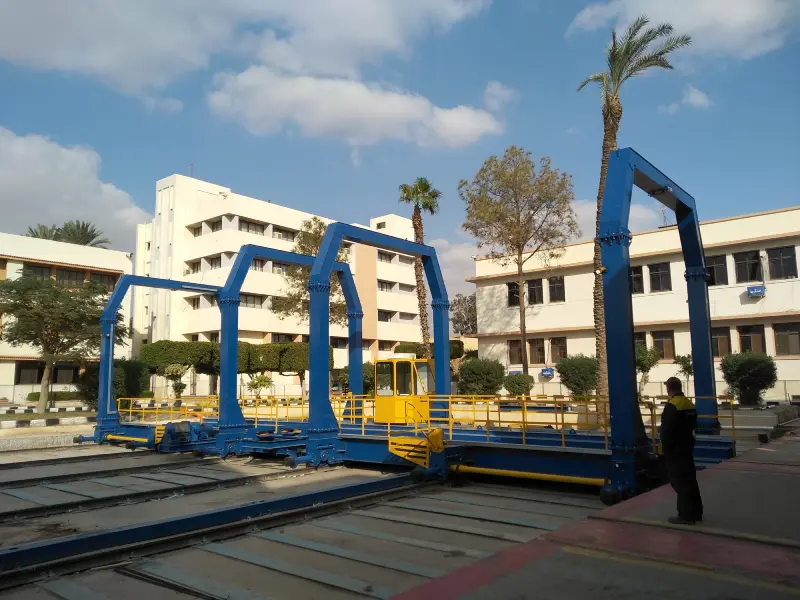
One common solution is the railway transfer table, which moves railcars and large structures between parallel tracks or production areas. A modern transfer table can be equipped with automatic positioning, variable-frequency drives, a PLC controller, safety systems and an operator interface.
Integrating the transfer table with the plant’s production system makes it possible to automate job handoff and track the part’s position as it moves.
Automated storage for steel stock and components
How well a robotic welding or assembly area performs depends directly on how reliably and promptly it receives metal stock and components. If a blank arrives late, sits untracked, or has to be hunted down manually between operations, the throughput of expensive robotic equipment drops — the bottleneck turns out to be warehouse logistics, not the welding process itself.
Sheet and profile metal stock is commonly stored in automated vertical or rack-type storage systems, where material is held in an orderly way by location and a specific sheet or profile is retrieved automatically on request from an operator or a production order. This approach noticeably reduces the floor space a warehouse takes up, prevents the damage that comes with haphazard stacking, and allows accurate tracking of remaining stock for every item.
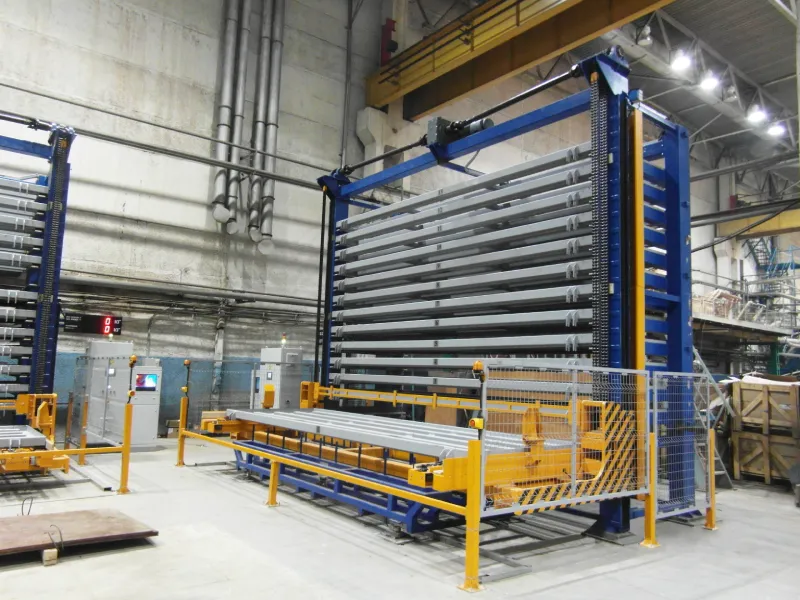
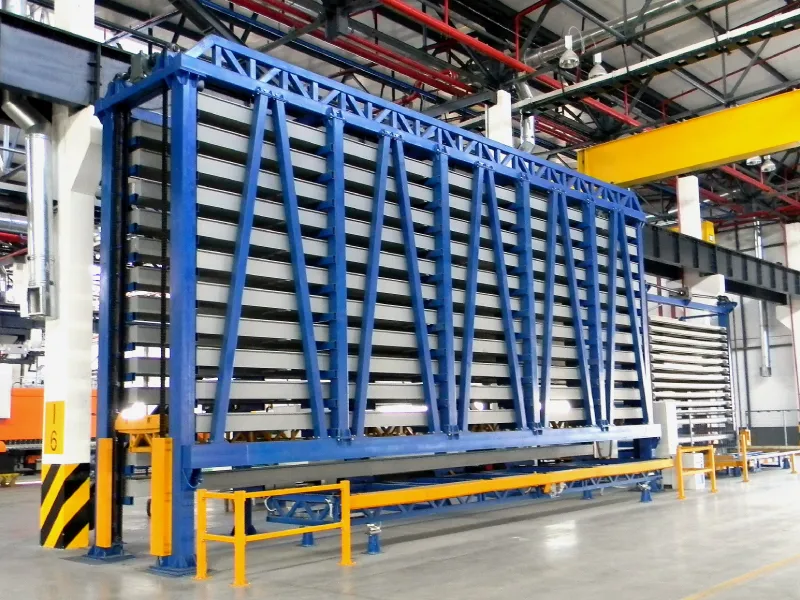
The same principle applies to storing components — fasteners, subassemblies, and small welded or machined parts used in large quantities during railcar assembly. An automated component store provides piece-level tracking, reservation against a specific production order, and largely eliminates the mix-ups that are almost unavoidable on a manual shelf with a large number of part numbers.
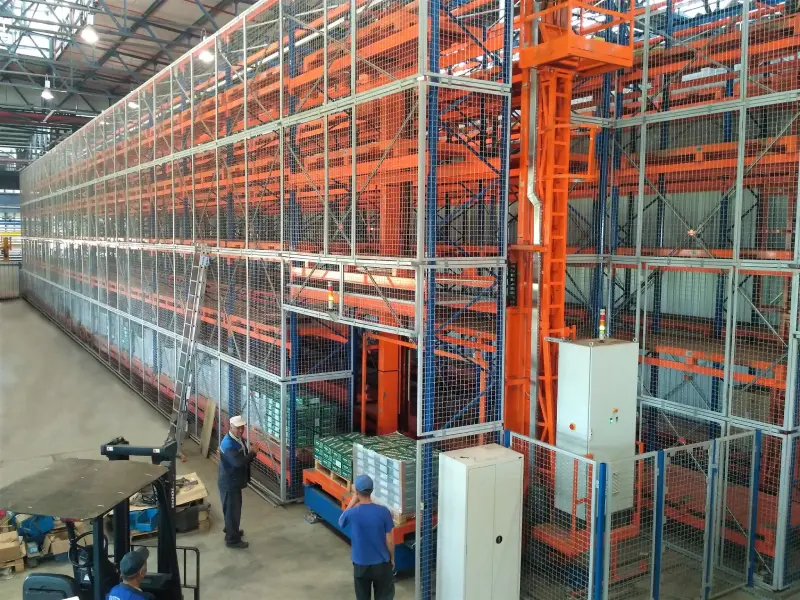
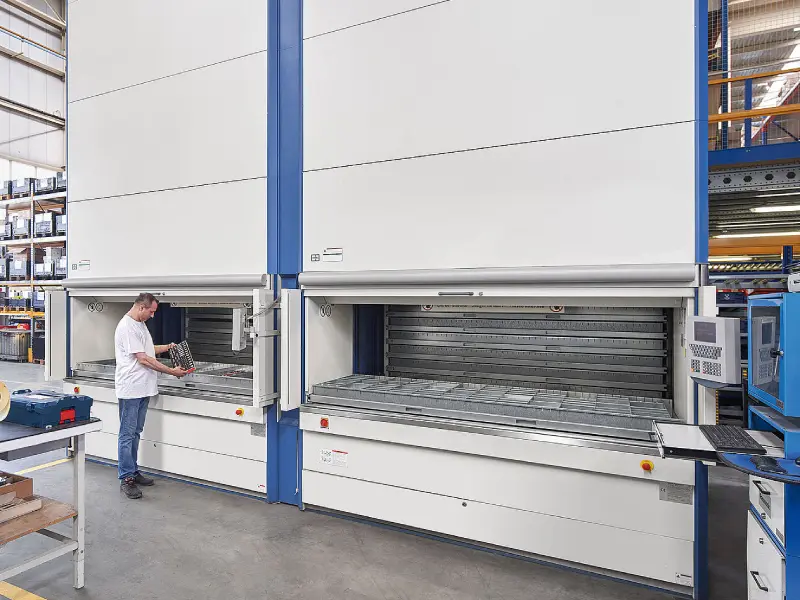
These systems add particular value when integrated with the plant’s production system: the warehouse receives an order from MES or ERP, assembles and issues the material kit for that order, and reports consumption data back — closing the loop of “warehouse → production area → stock control” into the same digital framework described earlier for robotic cells. Solutions of this kind — including the VerMet line of automated storage systems — apply equally to sheet metal stock and to component storage at railcar manufacturing and repair plants. See the product catalog for details.
Automating positioning and turning
When welding large structures, the orientation of the part relative to the welding tool matters a great deal: the less welding has to be done in an awkward position, the easier it is to keep the process stable. Welding positioners, turntables, turning fixtures, lift stands, two-column positioners and tilt-and-turn centering devices are used for this purpose.
A two-column positioner, for example, can lift and rotate a welded structure, keeping the part in the right orientation throughout the operation. Paired with an industrial robot, this kind of equipment becomes a single robotic process cell.
Automating shot blasting
After a welded structure is fabricated, the metal surface needs to be prepared for painting. Shot blasting can also be automated — using blast wheel chambers, pass-through blasting machines, equipment for sheet metal and profiles, chambers for large structures, and specialized systems for pipe and other products.
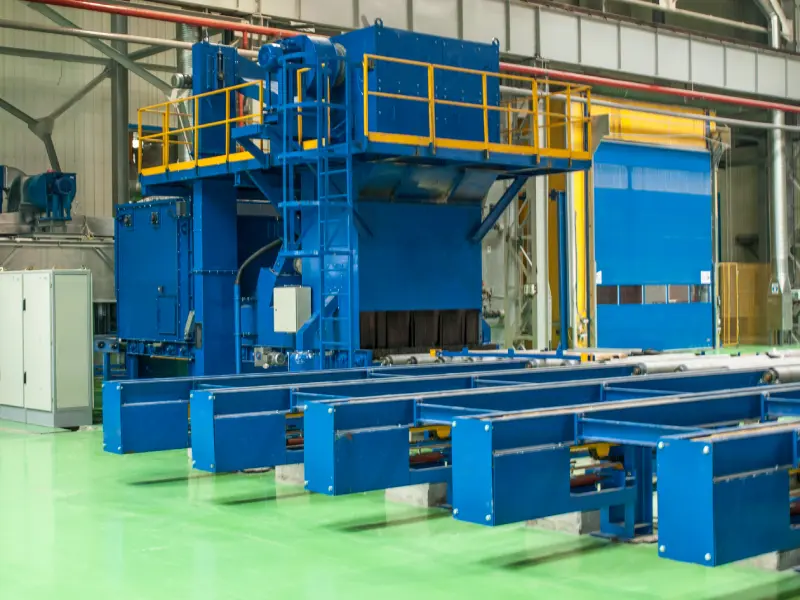
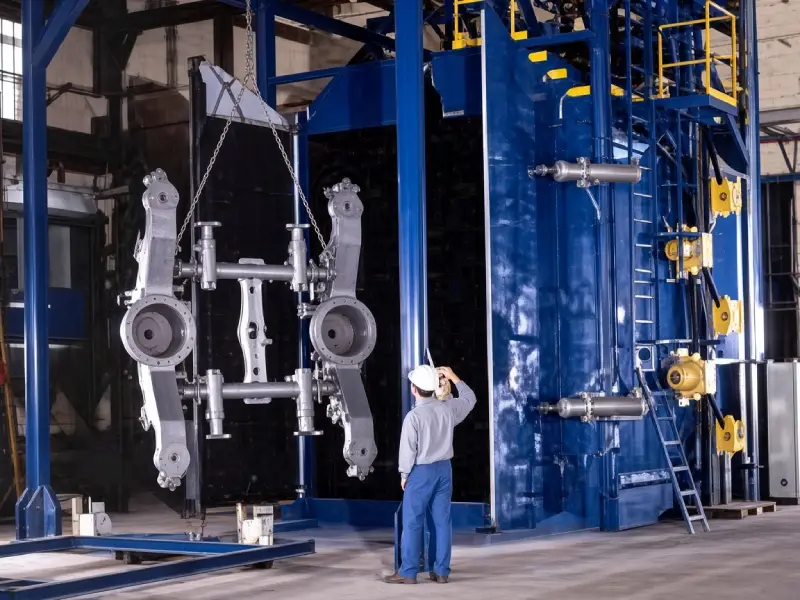
Automation makes surface preparation more consistent and allows process parameters to be monitored. For large railcar plants, pass-through lines — where a part moves through several process steps in sequence without manual handling in between — are particularly effective. See the catalog for equipment details.
Robotic shot blast cleaning of railcars
A distinct branch of shot blast automation is robotic cleaning of large welded structures — a full car body, an underframe, or an entire hopper car — in cases where the part is too large or too irregular in shape to pass through a standard blast chamber with fixed blast wheels.
Here the blast wheel or nozzle is mounted on a manipulator — an industrial robot or a dedicated robotic platform — that moves along and around the part being cleaned. The motion path is programmed for the geometry of a specific car type, which makes it possible to reach hard-to-access areas such as the inner surfaces of the frame, weld seams, and body joints, with a consistent result across the whole surface — unlike manual blasting, where quality depends on the operator’s position and fatigue.
A well-known example of this technology on the market is the Blastman range of robotic blast cleaning systems (Finland), used for cleaning large welded structures, ship hulls and rolling stock. Examples like this illustrate the broader direction the industry is moving in: away from fixed-geometry blast chambers and toward flexible robotic systems that can adapt to different part types and sizes.
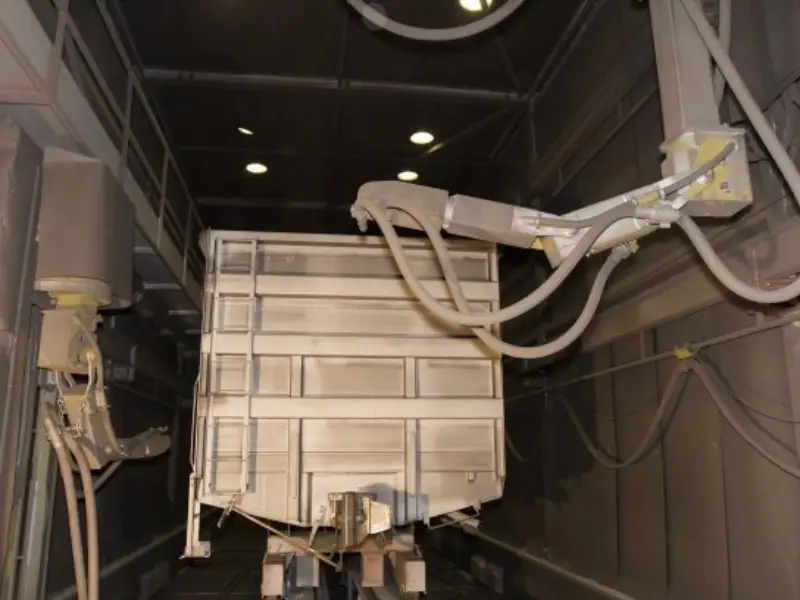
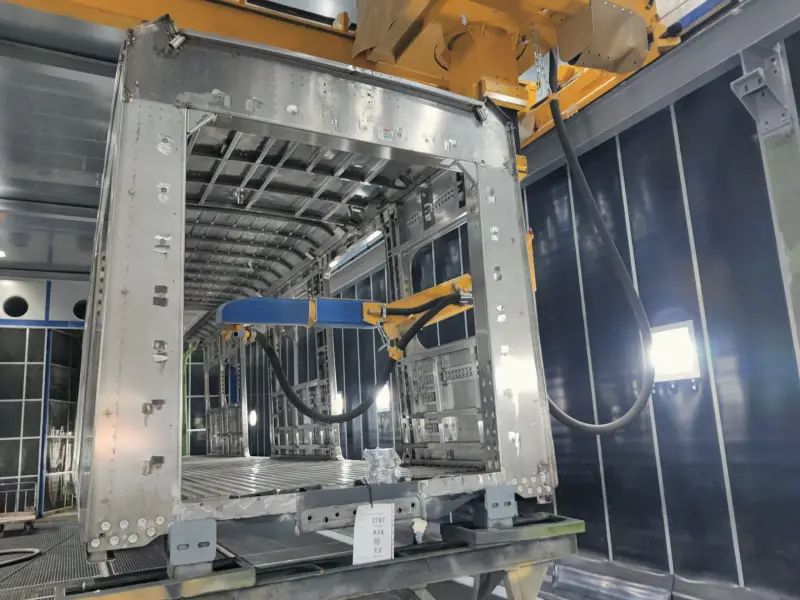
Robotic shot blasting of railcars Blastman
Robotic shot blasting of railcars Blastman
For a railcar manufacturing or repair plant, robotic shot blast cleaning is particularly worthwhile where the mix of parts varies widely in size and shape, and where reducing worker exposure to abrasive dust and noise matters — by moving the operator out of the work area and into a control room. Choosing this kind of solution means weighing throughput requirements, available shop floor space, and compatibility with adjacent stages: part handling, abrasive recovery, and the painting step that follows.
Robotizing railcar painting
Painting the car body is another process with real automation potential. Industrial robots can apply coatings to large surfaces with a consistent tool speed, a repeatable path, and even coverage. Programming different modes also reduces how much workers come into direct contact with paint materials.
A robotic paint system still has to be engineered together with the paint booth, ventilation, filtration, air handling, and the application equipment itself.
Automated quality control
The next stage in automated production is automating inspection itself. Laser scanners, machine vision systems, position sensors, measurement systems, geometry control systems, and automatic logging of welding parameters are all used for this.
A laser scanner, for example, can capture the geometry of a large structure and compare it against the intended digital model. This makes it possible to catch deviations before the part moves on to the next production step.
Integrating equipment into digital production
Modern automation is not just about running individual operations automatically — the next level is tying equipment together into a single information system for the plant. A typical structure follows the chain: ERP → MES → production area → PLC → robotic equipment → sensors and control systems.
An MES system can receive a production order, route it to a specific area, and collect data on how the work was carried out. This gives the plant visibility into equipment status, order progress, workcenter load, cycle times, downtime, fault stops, process parameters, and the processing history of a specific part.
What robotics delivers for a railcar plant
Robotics is not an end in itself — its value has to be judged against concrete production metrics.
Higher throughput
A robotic cell can run repetitive operations for long stretches of time with minimal breaks.
More consistent quality
A programmed motion path lets the same operation be repeated with a high degree of reproducibility.
Less reliance on manual labor
Automating the most repetitive operations frees up skilled people for more complex work.
Improved safety
Automated systems can take on operations involving high heat, welding fumes, abrasive blasting and other hazards.
Better production visibility
Integrating equipment with digital systems gives plant management objective data on how each area is performing.
When robotics actually pays off
Not every operation is worth robotizing. The best candidates are processes with high repeatability, stable part geometry, sufficiently large production volumes, a clearly defined process, and the ability to position the part automatically. For a plant producing large quantities of identical parts, investing in a robotic cell can have a clear, predictable payback.
For low-volume production, the picture is more complicated: fast changeover, flexible tooling, the ability to program several different parts, automatic mode switching, and digital process cards all become critical. Cost-effectiveness has to be calculated separately for each plant.
Where to start with robotics at a railcar plant
Successful robotics projects don’t start with picking a robot. The first step is analyzing the existing production process: identifying which operations are the most labor-intensive, where bottlenecks occur, which operations repeat, where queues and downtime build up, which operations affect quality, what equipment is currently in use, how parts move between operations, what production volumes are planned, and how much the product mix is likely to change.
From there, the area with the greatest automation potential can be identified. The next step is developing the technical solution, which usually includes a process layout, robotic equipment, specialized tooling, positioners, a transport system, control systems, sensors, safety systems, software, and quality control systems.
A systems approach to automation
One of the most common mistakes in plant modernization is automating a single operation without accounting for the processes around it. Installing a robotic welding cell, for example, can significantly speed up welding — but if assembly ahead of it can’t keep pace, and the finished part then sits waiting for transport afterward, overall throughput for the area barely changes.
Effective automation has to consider the entire process flow: raw material → assembly → positioning → welding → inspection → turning → surface treatment → painting → inspection → transport → next step. Automating one link has to be matched to the throughput of the others.
Robotics as part of modernizing railcar production
A modern railcar plant is gradually turning from a collection of separate machines and areas into an integrated production system. Robots, automated lines, transfer tables, positioners, control systems and software all need to work together as a single technological complex.
This kind of automation usually happens in stages: from mechanizing individual operations, to automating process steps, to robotizing repetitive operations, to automating material handling and positioning, to automated quality control, to integrating equipment with MES/ERP, and finally to building a fully digital production loop. This path lets a plant modernize without replacing its entire production infrastructure at once.
An engineering approach to robotics
Robotizing railcar production draws on several areas of expertise at once: railcar manufacturing technology, welding, industrial robotics, automation, mechanical engineering, electrical engineering, PLC programming, industrial safety, tooling design, and production logistics.
That is why designing a robotic area has to be treated as a complete engineering project. The goal isn’t simply to pick an industrial robot, but to work out the right configuration for the whole system based on the part, the process, required throughput, and the plant’s specific requirements. Examples of completed projects are available on the Implemented Projects page.
Conclusion
Automation and robotics are becoming one of the key directions in modern railcar manufacturing. The greatest potential lies in welding, assembly, positioning, material handling, shot blasting, painting and quality control.
Effective robotics is not about replacing people with robots. It’s about restructuring the process itself, so that robotic equipment, tooling, control systems, transport devices and quality control come together as a single production system. For manufacturers of freight and passenger railcars, as well as repair plants, automation can become a tool for raising throughput, stabilizing quality, and gaining better visibility into production.
Techvagonmash designs and builds process equipment and turnkey solutions for automating and robotizing production processes. Depending on the task, a project can include designing the process area, developing specialized equipment and tooling, robotic welding cells, positioners and turning fixtures, automated transport systems, control systems, and integrating equipment into the production process.
Browse ready-made solutions in the product catalog and on the turnkey projects page. To discuss a specific project, contact us.
FAQ
Where should a railcar manufacturer start with robotics?
Not with choosing a robot, but with analyzing the current production process: which operations are the most labor-intensive, where the bottlenecks and downtime occur, and which operations are repetitive and affect quality. Once this is clear, the area with the greatest automation potential is identified, and the technical solution — the robot, tooling, positioning, transport system and control — is engineered together as one system.
Is robotic welding always cost-effective for low-volume production?
Not automatically. For large runs of identical parts the payback is more predictable. For low-volume production, the economics depend on changeover speed, tooling flexibility, the ability to store and switch between several welding programs, and digital process cards. Cost-effectiveness has to be calculated separately for each plant.
What does a robotic welding cell include besides the robot itself?
The industrial robot is only one part. A complete cell also includes a welding power source and torch, a positioner or turntable, fixturing to locate the part, a wire feed system, sensors, safety guarding, a control system, a fume extraction system, and software.
Can automation be rolled out in stages rather than across the whole plant at once?
Yes — this is the standard practical approach: from mechanizing individual operations, to automating technological processes, to robotizing repetitive operations, to automating material handling and positioning, to automated quality control, and finally to integrating equipment with MES/ERP. This path allows a plant to modernize without replacing its entire infrastructure at once.
Which railcar manufacturing processes are the best candidates for robotics first?
Operations with high repeatability and stable part geometry come first: welding of side and end walls, center sills, frames and bogie components, along with shot blasting and the handling of large structures between process stations.
Related articles
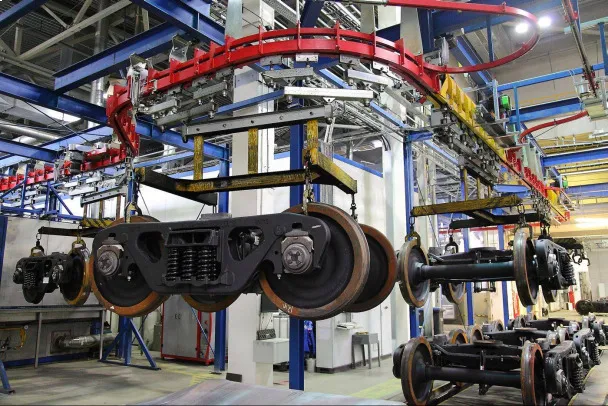
Wagon building is a serial production business, where every minute of line downtime multiplies across the number of units in the output schedule. Unlike a repair cycle, this isn't about a single item — it's about repeatability: thousands of identical welds, hundreds of identical car body assemblies, stable geometry shift after shift.
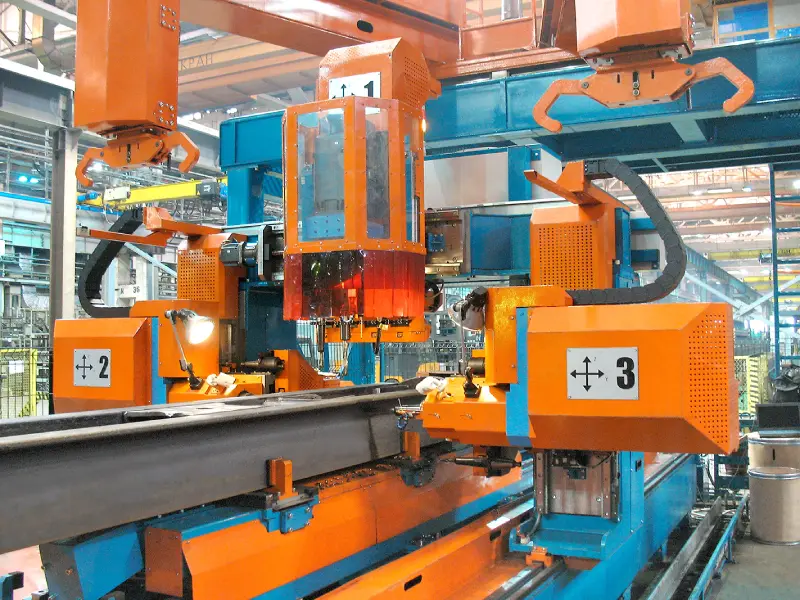
This article covers three automated drilling systems, the engineering approach behind them, and the turnkey solutions Techvagonmash offers to railcar builders and repair shops. The advantages of this equipment class stand out most clearly when compared with the conventional methods still used across much of the transport machinery industry.
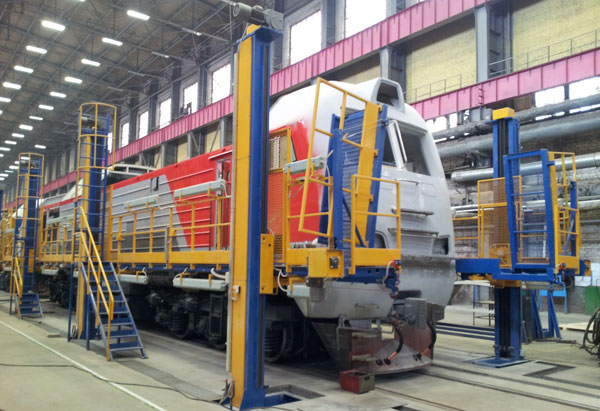
Traditionally, fixed platforms have been used at railcar manufacturing plants for exterior finishing and final body processing. However, conventional solutions have significant drawbacks: limited lifting range, difficulty in positioning workers at the required height, non-compliance with modern industrial safety standards, and inconvenient operation.
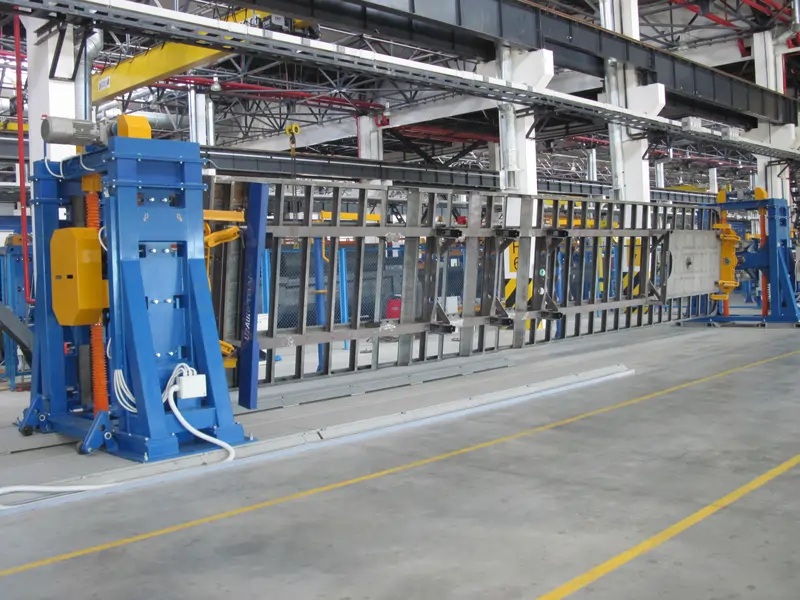
This article discusses the main advantages of using positioners when welding.