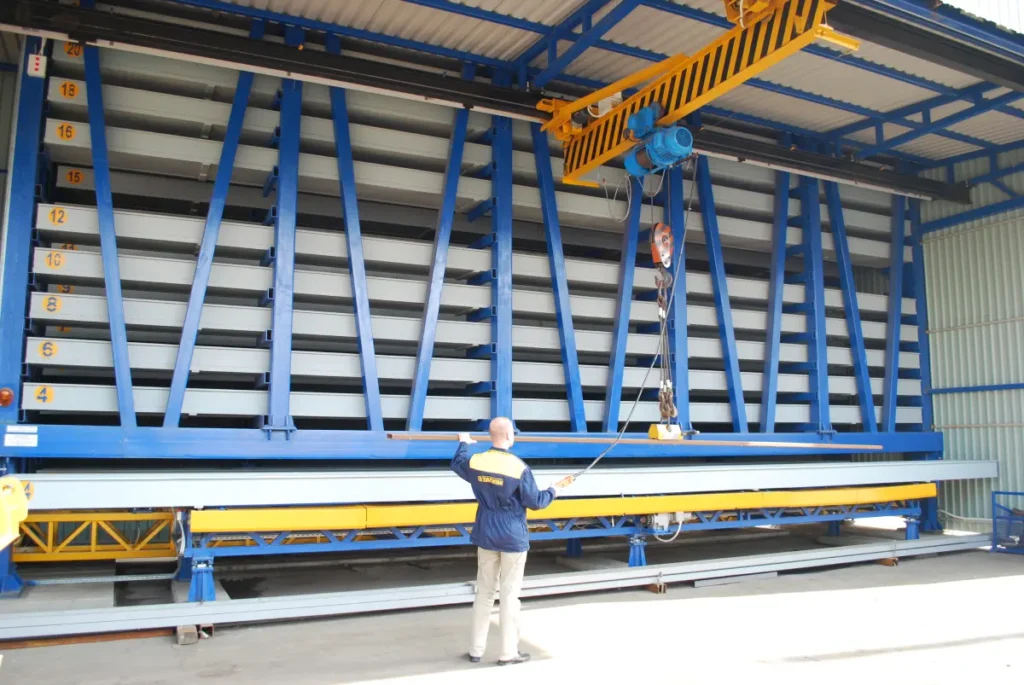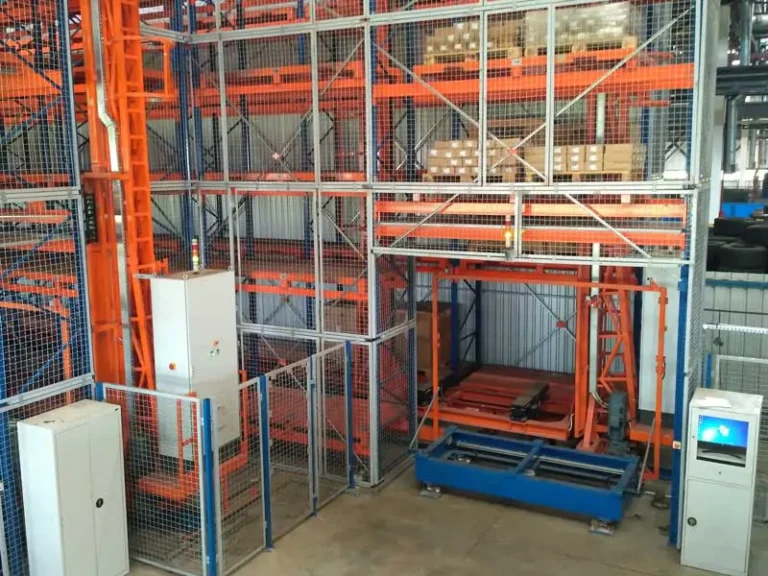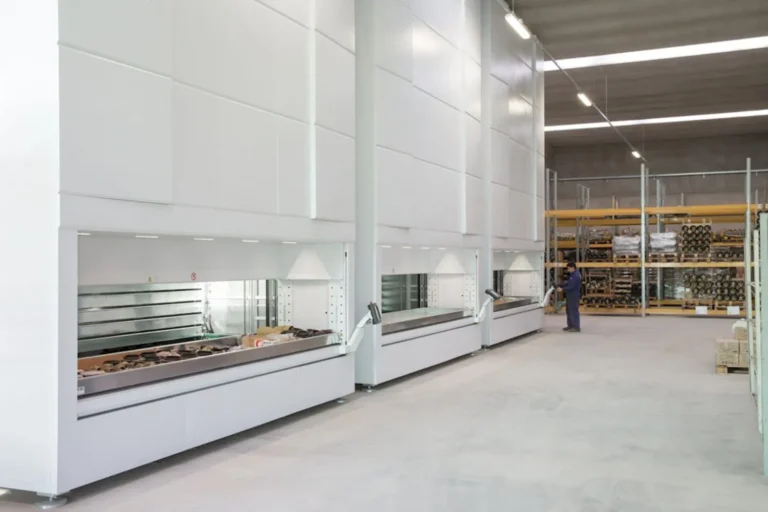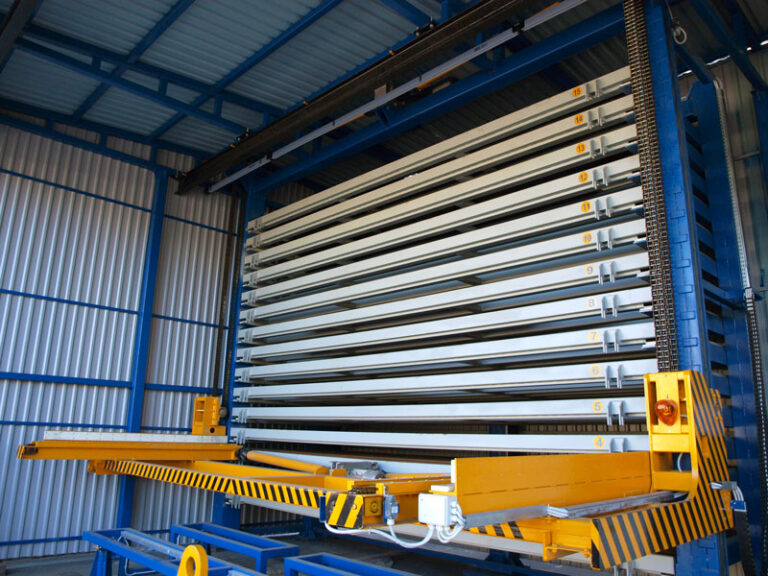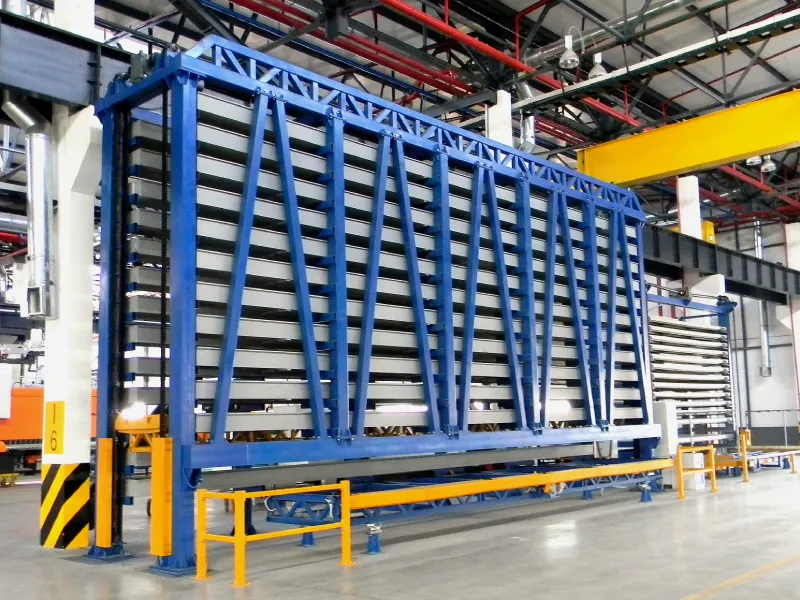
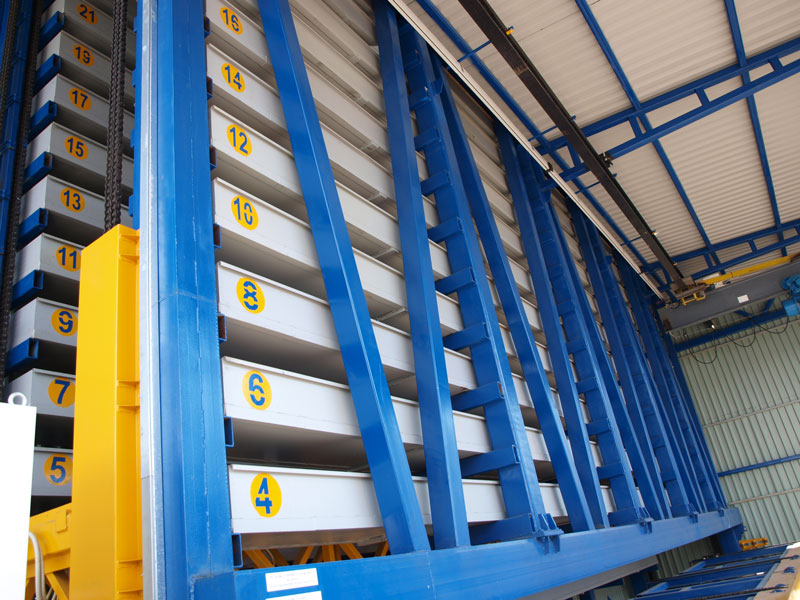
Automated long goods storage is a purpose-built warehousing solution for storing metal profiles, pipes, bars, structural sections and other elongated materials in a space-efficient, fully controlled manner. Unlike conventional floor-level storage, automated systems keep every item in designated cassette cells, managed by an onboard control system and retrievable on demand — without forklifts, manual searching, or risk of product damage.
Techvagonmash designs and manufactures automated long goods storage systems tailored to each customer’s product range, building dimensions and production workflow. Our systems have been integrated into railcar manufacturing facilities, metalworking shops, and heavy engineering plants across the CIS and Eastern Europe.
Video
Benefits of Automated Long Goods Storage
Switching from conventional rack or floor storage to an automated system delivers measurable results from the first weeks of operation:
- Up to 60% reduction in floor space — vertical stacking in cassette cells replaces sprawling ground-level storage lanes.
- Faster material feed to production — the system delivers a required cassette to the loading station in under 2 minutes, eliminating crane queuing and manual search time.
- Full inventory control — every cassette is tracked by weight sensors and optionally by RFID or barcode, giving real-time stock visibility in your WMS or ERP.
- Reduced staffing requirements — one operator handles loading and retrieval; no specialised crane operators or stackers required for routine operations.
- Improved workplace safety — long materials never rest on the floor or in unstable stacks; overload and skew sensors prevent cassette accidents.
- Simplified production routing — integrated inter-stage transport systems feed material directly to cutting, bending, punching or welding stations.
Industries and Applications
Our automated long goods storage systems are engineered for industrial environments where precision, capacity and integration with production lines are non-negotiable requirements.
Railcar and rolling stock manufacturing
Storage of beams, channels, angles and pipes used in frame and bogie assembly. Integration with robotic welding cells and shot-blast lines ensures uninterrupted material supply without manual crane interventions.
Metalworking and metal distribution
High-turnover environments where multiple profile types (square and round bars, tubes, flat bars, RHS/SHS sections) need to be stored simultaneously and issued in FIFO order. The WMS tracks remnant lengths after cutting, reducing material waste.
Heavy and transport engineering
Structural steel components for large assemblies — girders, longitudinal members, reinforcing bars — can be stored in standard or extended cassettes up to 12.5 metres in length, feeding directly into assembly jigs or bending presses.
Automotive and trailer manufacturing
Chassis frames, cross-members and profile sections stored in a compact automated warehouse adjacent to the welding shop, with automatic feed to positioners and rotators.
Specifications:
| Load capacity, kg | 27000 | 54000 |
| Load capacity of the cell, kg | 1500 | 3000 |
| Number of cells, pcs. | 18 | 18 |
| Inner dimensions of the cell | 6450 х 600 х 240 | 12450 х 600 х 240 |
| Cross beam elevating/loweing speed, m/min | 14 | 14 |
| Traction equipment type | chain | chain |
| Cell travel speed along telescopic rails, m/min | 6 | 6 |
| Storage system dimensions, mm | 7520 х 3515 х 5860 (Н) | 13120 х 3515 х 5870 (Н) |
Request a price quote
System Configuration Options
Every Techvagonmash automated long goods storage system is custom-engineered to match your building, material range and throughput requirements. Key configuration parameters include:
Storage capacity and cassette dimensions
Standard configurations support cassette lengths of 6.45 m and 12.45 m with a cell load capacity of 1,500 kg or 3,000 kg respectively. Systems with total loads of 27 tonnes and 54 tonnes are available as standard; larger capacities are designed on request. Cell height and width can be adjusted to accommodate oversize or irregular cross-sections.
Crane and clamping options
The storage system can be fitted with an integrated overhead crane equipped with magnetic or mechanical clamps, suitable for angles, flat bars and stripes that cannot be handled by conventional chain slings. This eliminates the need for a separate shop crane and reduces handling time between storage and the first operation.
Inter-stage transport integration
Roller conveyors, shuttle tables and transfer cars can be coupled to the storage system exit station, feeding material to thermal or mechanical cutting lines, punching presses, bending machines, or directly to assembly fixtures. The transport system is synchronised with the storage controller to eliminate manual intervention between retrieval and processing.
Control and automation level
Standard: PLC-based control with operator panel and manual override. Advanced: WMS module with inventory database, remnant tracking and production order integration. Enterprise: full ERP interface (1C, SAP, or customer-specific API) with online stock visibility, consumption reporting and reorder alerts.
Video about the operation of automated storage systems for long loads
Case Studies
Client: Railcar manufacturing plant, Ukraine
Challenge: The customer stored structural profiles and pipes on ground-level racks across 120 m² of shop floor. Manual handling with an overhead crane required 2–3 workers per shift and caused frequent delays in material supply to the welding line.
Solution: A two-bay automated long goods storage system with a total capacity of 54 tonnes, integrated with a roller conveyor feeding directly to the cutting station. WMS module linked to the plant’s production planning system.
Result: Storage footprint reduced from 120 m² to 60 m². Material feed time to the cutting line reduced from 25–40 minutes to under 3 minutes. Staffing on the storage area reduced from 3 operators to 1.