Robotic welding is one of the key automation tools in modern manufacturing. Industrial robots make it possible to perform welding operations with high precision and repeatability, stabilize joint quality, increase throughput, and reduce the influence of the human factor.
Today, robotic welding cells are used in automotive manufacturing, railcar building, structural steel fabrication, agricultural machinery, general engineering and other industries that require large volumes of repetitive welding operations.
Robotizing welding is not simply a matter of installing an industrial robot in place of a welder. An effective welding cell combines a robot, a welding power source, a welding torch, tooling, a positioner or other process equipment, a control system, sensors and safety equipment.
Let’s look at how robotic welding works, which technologies are used, what a welding cell is made of, and when automation actually pays off.
Table of contents:
- What is robotic welding
- Main types of robotic welding
- Robotic arc welding
- Robotic submerged arc welding (SAW)
- Robotic resistance spot welding
- Robotic laser welding
- What a robotic welding cell consists of
- How robotic welding works
- Programming a welding robot
- Quality control in robotic welding
- Advantages of robotic welding
- Disadvantages and limitations
- When robotic welding makes sense
- Robotic welding in railcar building
- How to choose a robotic welding cell
- Key takeaway
- FAQ
What is robotic welding
Robotic welding is an automated process of joining metal parts in which an industrial robot moves a welding tool along a pre-defined path.
Unlike manual welding, process parameters and torch movement are set by a program. Once launched, the robot can repeat the same operation many times with minimal deviation.
A typical robotic welding system includes:
- an industrial welding robot;
- a robot controller;
- a welding power source;
- a welding torch;
- a wire feed system;
- a shielding gas supply system;
- welding tooling/fixtures;
- a positioner or turning device;
- sensors and monitoring systems;
- safety fencing;
- a process control system.
More advanced cells also use machine vision systems, laser sensors, and seam-finding and automatic path-correction devices.
Main types of robotic welding
The choice of robotic welding technology depends on the material, part thickness, joint type, part geometry, required throughput, and the required characteristics of the finished weld.
The most common technologies in industry are:
- MIG/MAG — robotic arc welding with a consumable wire electrode under shielding gas;
- TIG — welding with a non-consumable tungsten electrode;
- SAW — automated submerged arc welding;
- resistance spot welding;
- laser welding.
For structural steel fabrication, railcar components and other large-scale parts, MIG/MAG and SAW are of particular interest. These technologies make it possible to automate a large share of repetitive welding operations and ensure consistent joint quality.
1. Robotic arc welding
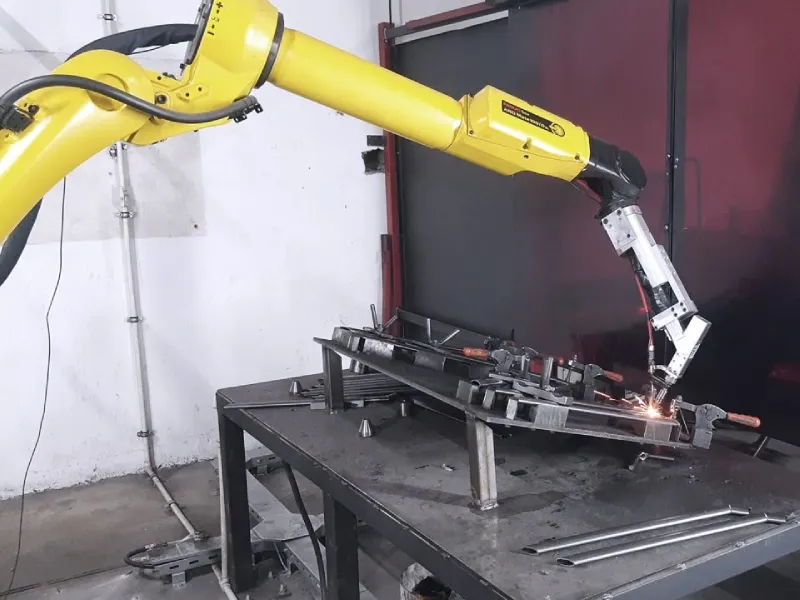
Arc welding is one of the most widely used forms of industrial welding robotization.
An electric arc forms between the electrode and the workpiece. The heat released melts the base metal and, when needed, filler material, forming the weld joint.
The robot moves the welding torch along a defined path while continuously maintaining the required process parameters.
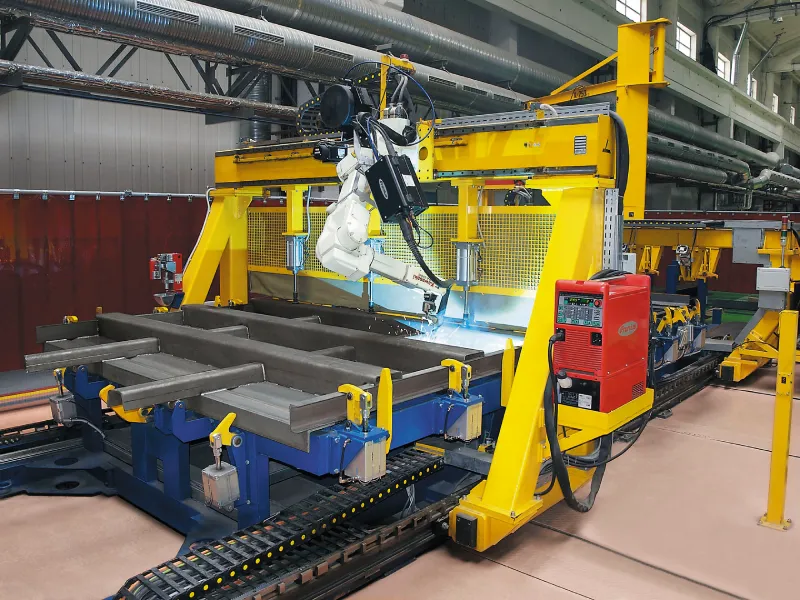
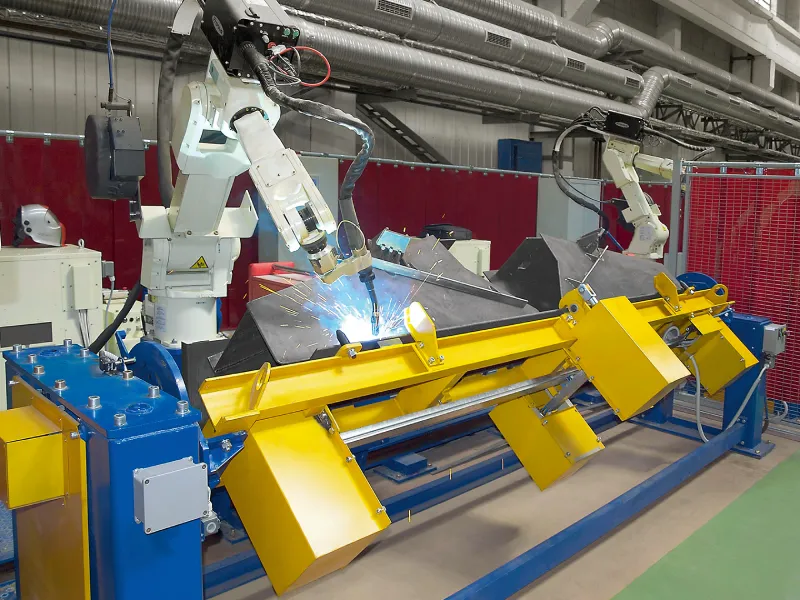
Widely used arc welding technologies include:
- MIG — welding under an inert shielding gas;
- MAG — welding under an active shielding gas;
- TIG — welding with a non-consumable tungsten electrode.
MIG/MAG is especially widely used for automated welding of steel structures.
Advantages of robotic arc welding
This technology makes it possible to:
- maintain consistent weld bead geometry;
- increase throughput;
- reduce the number of defects;
- reduce consumption of welding materials;
- achieve high repeatability of operations;
- automate long and complex weld seams.
Robotic arc welding is especially effective in serial production of parts with repeating geometry — for example, welding frames, body elements, railcar components, structural steel, supports, platforms and other large-scale parts.
Robotic submerged arc welding (SAW)
SAW (Submerged Arc Welding) is an automated arc welding process in which the electric arc and the weld pool are covered by a layer of granular flux.
Unlike MIG/MAG, in SAW the welding arc is not visible to the operator: it is fully covered by the flux layer. The flux shields the weld pool from the atmosphere, helps stabilize the process, and forms a slag layer that protects the metal as it cools.
SAW is especially effective for welding thick metal, long straight seams and large welded structures. Thanks to its high productivity and high deposition rate, the technology is widely used in heavy machine building, shipbuilding, structural steel fabrication, railway equipment, tanks, pipes and power generation equipment.
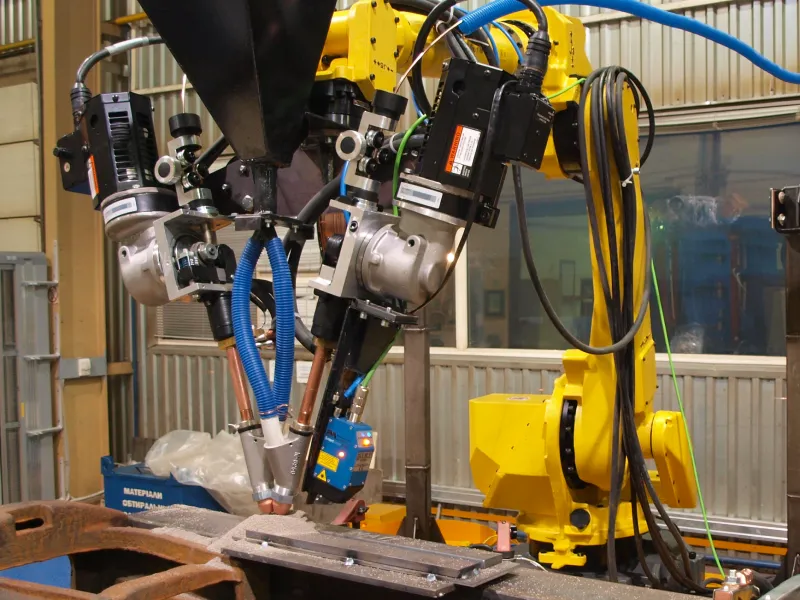
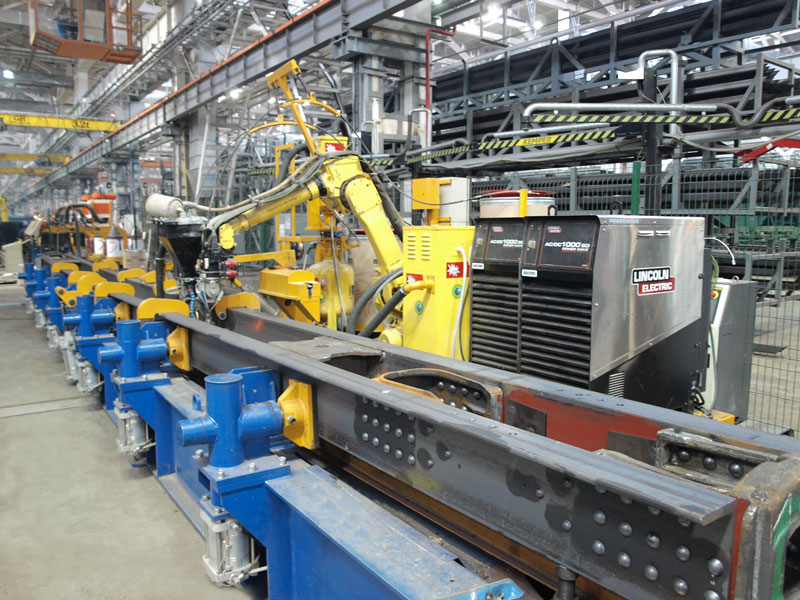
How SAW works
During welding, a continuous welding wire is fed into the joint area. At the same time, granular flux is fed onto the surface of the workpiece.
An electric arc forms between the electrode and the workpiece. Its heat melts the welding wire and the base metal, forming a weld pool. The flux layer shields the arc and the molten metal from the surrounding atmosphere.
After the weld cools, the resulting slag is removed, and unmelted flux can be collected and returned to the process by suitable recovery systems.
SAW automation uses welding heads, mechanized carriages, columns and booms, gantry systems, positioners, rotators and industrial robots.
Why SAW is well suited to robotization
Submerged arc welding is inherently well suited to mechanization and automation, because the process is most efficient when performing long, continuous seams with a constant or predictable geometry.
A robot or other automated manipulator provides:
- a stable trajectory for the welding head;
- a constant welding speed;
- precise electrode positioning;
- repeatability of process parameters;
- automatic execution of long weld seams;
- reduced dependence of the result on operator skill.
A robotic SAW system can be integrated with positioners and rotators, allowing the workpiece to be optimally oriented relative to the welding head.
Advantages of robotic SAW
High productivity. One of SAW’s main advantages is a high deposition rate. In heavy manufacturing this allows a significant increase in output compared with less productive welding methods. Single-wire, twin-wire and tandem welding configurations can be used to further increase productivity.
Deep penetration. SAW provides deep penetration, making the technology especially effective for joining thick metal parts.
Consistent weld quality. Automation makes it possible to maintain constant process parameters and welding head position, increasing the repeatability of the welds.
Minimal spatter. Because the arc and weld pool are covered by flux, spatter and exposure to an open arc are significantly reduced, also making conditions more comfortable for the operator.
High efficiency on long seams. SAW is especially cost-effective for long straight or circumferential welds, which is why the technology is widely used for large welded structures, tanks, pipes, beams and similar products.
Limitations of SAW
Despite its high productivity, submerged arc welding is not a universal technology. Key limitations include:
- the need to keep a layer of granular flux over the weld zone;
- a preference for the flat position and other positions that allow stable flux retention;
- limited effectiveness on complex geometry and hard-to-reach joints;
- the need to remove slag after welding;
- greater equipment complexity compared with manual or semi-automatic welding;
- economic sense mainly in serial production and high welding volumes.
SAW is therefore most effective where a stable part position and a long, continuous welding path can be provided.
Where robotic SAW is used
Submerged arc welding is used in industries that need to join large, thick-walled metal components with high productivity:
- railcar building and the railway industry;
- production of frames and large structural steel components;
- heavy machine building;
- shipbuilding;
- production of tanks and pressure vessels;
- manufacturing of pipes and pipe structures;
- production of beams and columns;
- power generation equipment;
- production of wind turbine towers and sections.
SAW in railcar and structural steel production
For railcar manufacturers, SAW can be an effective solution for automating the welding of components with long weld seams and relatively stable geometry.
Depending on the part design, a robotic cell may include:
- an industrial robot or welding manipulator;
- a SAW welding head;
- a welding power source;
- a wire feed system;
- a flux feed and recovery system;
- a positioner or rotator;
- dedicated welding tooling;
- a seam-tracking system;
- a control and safety system.
Such a cell combines several process operations into a single automated system. For large-scale parts, the right combination of welding manipulator, positioner and process tooling is especially important: the positioner changes the workpiece’s position, while the robot or welding column ensures precise movement of the welding head along the defined path.
As a result, SAW becomes not a stand-alone welding operation but part of a comprehensive automated production line.
2. Robotic resistance spot welding
Resistance spot welding is based on passing electric current through parts being joined under pressure. Heat is generated at the point of contact, the metal is locally heated, and a weld nugget is formed.
Robotic spot welding systems are especially common in the automotive industry, where a large number of identical welds must be made on body panels.
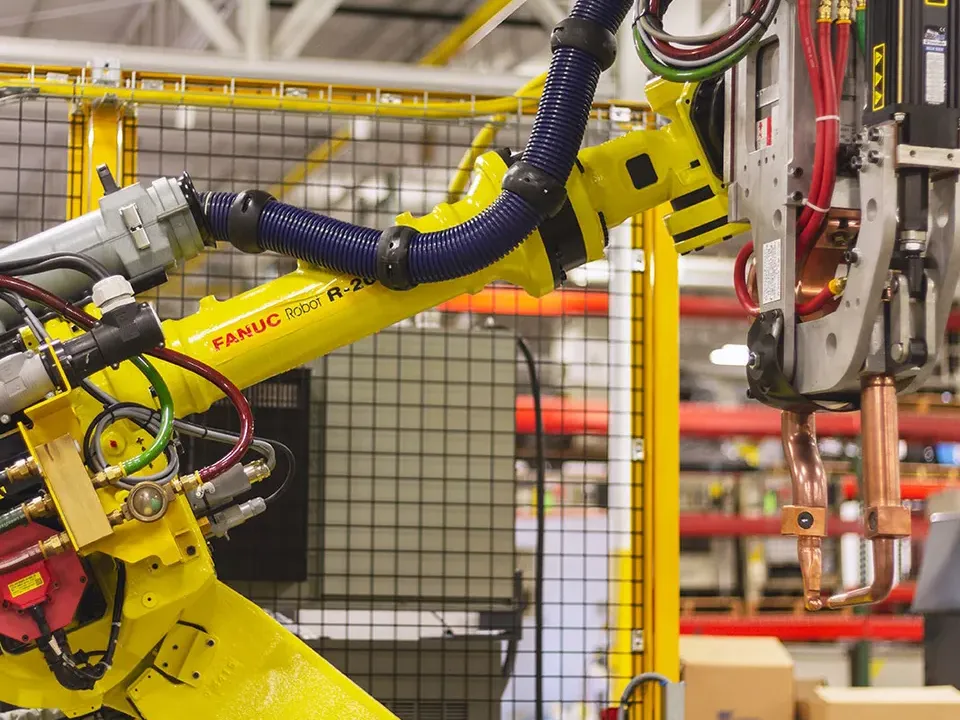
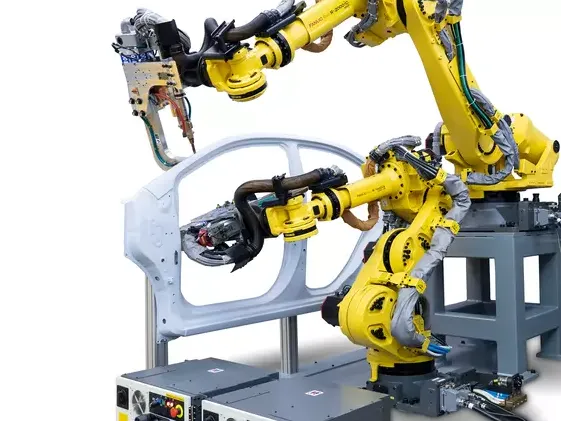
Key advantages of the technology:
- high speed;
- consistent quality;
- repeatability;
- the ability to automate a large number of weld points;
- high throughput for serial production.
However, the technology has limitations — for example, welding tool access to certain parts of a structure can be difficult.
3. Robotic laser welding
Laser welding uses a concentrated laser beam as the heat source. High energy density enables precise welds with a relatively small heat-affected zone.
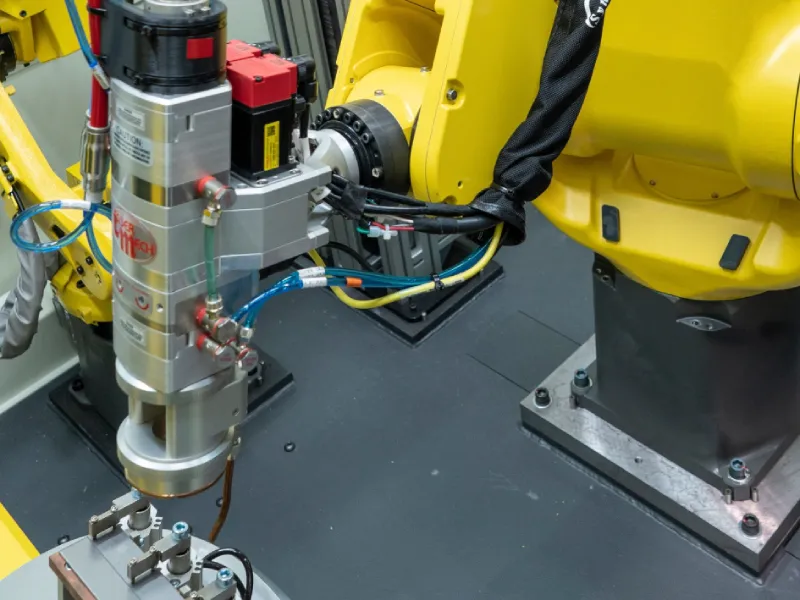
Robotic laser welding is used where the following are especially important:
- high precision;
- speed;
- minimal part distortion;
- weld surface quality;
- the ability to weld small and complex components.
The technology is used in electronic component manufacturing, the automotive industry, aerospace, medical device manufacturing and other fields. The cost of laser welding equipment and the required positioning precision make it more complex to implement than conventional arc welding.
What a robotic welding cell consists of
The effectiveness of automated welding is determined not only by the characteristics of the industrial robot. A complete robotic welding cell is a set of equipment operating as a single process system.
Industrial welding robot
The robot performs the main motion of the welding tool. Six-axis industrial robots are typically used, allowing the welding torch to be positioned in a wide range of spatial orientations.
When selecting a robot, the following are considered: payload capacity, working envelope, number of axes, positioning accuracy, travel speed, allowable wrist moment, type of welding equipment, and part-specific characteristics.
For robotic welding, positioning accuracy matters, but so does the robot’s ability to maintain a stable speed and torch orientation across the entire path.
Welding torch
The welding torch is the cell’s direct working tool. In MIG/MAG welding, it provides wire feed, shielding gas delivery, current transfer, and formation of the welding arc.
Torch design must match the welding process parameters and part geometry. Even relatively small deviations in torch position, incorrect shielding gas flow, or worn consumables can affect weld quality.
Welding power source
The power source supplies the electrical parameters required for the welding process. In a robotic system, it interacts with the robot controller and the other elements of the cell.
For arc welding, key parameters include welding current, voltage, wire feed speed, welding speed, shielding gas type and arc characteristics. Modern power sources allow programmable control of welding parameters and storage of process settings for different operations.
Welding tooling/fixtures
One of the most underrated components of robotic welding is process tooling. Even the most precise industrial robot cannot deliver stable quality if parts are positioned differently each time.
Tooling must securely clamp parts, ensure repeatable component positioning, prevent movement during welding, allow torch access, and minimize load/unload time. Complex parts require dedicated jigs and automated clamping systems.
Positioners and turning devices
When welding complex spatial structures, a robot may work together with a positioner. The positioner reorients the workpiece so that the weld seam is in the optimal position relative to the torch.
This reduces the number of complex spatial robot movements, improves welding quality, increases process speed, provides a more favorable weld position, and reduces the number of part re-fixturing steps.
In heavy machine building, two-axis positioners, turning devices, tilters and specialized positioning systems for large parts may be used.
Sensors and seam-tracking systems
One of the challenges of robotic welding is the difference between the actual part position and the position programmed into the system. Causes can include manufacturing tolerances, part distortion, assembly error, gap variation, and thermal deformation.
For this reason, modern robotic welding cells can be equipped with seam-finding and seam-tracking systems. Sensors detect the actual joint position and correct the torch’s trajectory — this is especially important when welding large structures and parts where small geometric deviations can significantly affect the result.
How robotic welding works
The operation of a welding cell can be broken down into several stages:
- Part preparation. Parts are placed into the process tooling and clamped in the required position.
- Program loading. A program containing the motion path and welding parameters is loaded into the robot controller.
- Position check. The system determines the workpiece’s starting position and adjusts the trajectory if needed.
- Welding. The robot moves the torch along the defined path while maintaining the required process parameters.
- Process monitoring. The system monitors welding parameters and tool position.
- Operation completion. Once the weld is finished, the robot returns to its home position and the finished part is passed to the next production stage.
Programming a welding robot
Programming is one of the most important steps in setting up a robotic welding cell. The program must define the motion path, welding speed, torch position and angle, welding current, voltage, wire feed speed, weld sequence, shielding gas on/off timing, and positioner parameters.
Modern software allows paths to be created and simulated in a virtual environment. This makes it possible to validate the cell’s operation before it is commissioned and to shorten equipment start-up time.
According to Wevolver, modern programming and simulation systems can significantly reduce the time needed to prepare a robotic welding process.
Quality control in robotic welding
Automation does not eliminate the need for weld quality control. On the contrary, a modern robotic system must ensure control of both the process itself and the finished part.
Parameters monitored include: weld geometry, penetration depth, weld width, porosity, cracks, undercuts, lack of fusion, spatter, and process parameter stability.
Depending on requirements, visual inspection and various non-destructive testing methods — including ultrasonic and radiographic testing — may be used.
Advantages of robotic welding
The main reason for adopting welding robots is the ability to make the production process more stable, faster and more controllable.
Increased productivity
A robot can operate for long periods with minimal downtime and perform repetitive operations at high speed — especially valuable for serial production.
Consistent weld quality
Once properly set up, a robot repeats the defined path and process settings with high precision, reducing dependence on any individual welder’s skill.
High repeatability
One of the key features of robotic welding is the ability to perform thousands of identical operations with nearly identical parameters.
Fewer defects
A controlled trajectory and stable process parameters help reduce the likelihood of defects such as undercuts, lack of fusion and excessive penetration.
Reduced material consumption
Precise control of the arc and trajectory can reduce consumption of welding wire, gas and other consumables.
Improved safety
The robot takes on operations exposed to high temperature, welding radiation, fumes and molten metal spatter, while the operator monitors the process from a safe zone.
Lower cost per part
With sufficient equipment utilization, automation reduces labor cost per unit and increases output without a proportional increase in headcount.
Disadvantages and limitations of robotic welding
Despite its many advantages, robotic welding is not suitable for every production environment.
High upfront investment
Project cost covers more than the industrial robot alone: welding equipment, positioners, tooling, safety fencing, safety systems, sensors, software, engineering, integration and staff training must all be accounted for. Robotic welding therefore requires a preliminary feasibility study.
Programming requirements
Commissioning a robotic cell requires developing and debugging process programs. A change in part design may require program adjustment or a complete rewrite.
Part geometry requirements
The more stable a part’s dimensions and position, the easier it is to maintain a stable robotic process. Large manufacturing tolerances and significant distortion can complicate automation.
Need for qualified personnel
Operating and maintaining a cell requires specialists who understand welding technology, robotics, programming, electrical equipment and automation systems simultaneously.
Limited cost-effectiveness for low-volume production
If a plant produces a small number of parts that differ significantly from one another, robotization may not be economically justified. In such cases, manual or semi-automatic welding may be a more flexible solution.
When robotic welding makes sense
Before purchasing equipment, several factors should be assessed. Robotization is especially effective when:
- the plant produces serial output;
- welding operations are regularly repeated;
- production volume needs to increase;
- quality consistency requirements are high;
- there is a shortage of qualified welders;
- the part has stable geometry;
- weld seams follow a predictable path;
- the plant is planning long-term productivity growth.
Robotization does not necessarily mean full production automation. Often, the most effective solution is to automate the most labor-intensive operations while retaining manual welding for complex or irregular joints.
Robotic welding in railcar building
Robotic welding is of particular interest to railcar manufacturers. Production of freight wagons, platforms, gondola cars, frames and other structural steel components involves a large number of repetitive welding operations.
Robotic cells can be used for:
- welding railcar frames;
- fabricating body elements;
- welding side walls;
- welding end structures;
- fabricating bogie/truck components;
- producing welded structural steel assemblies;
- welding container and platform components.
For large-scale parts, the robot’s combined operation with positioners, tilters, dedicated tooling and transport systems is especially important. It is precisely this integrated approach that delivers the maximum benefit from automation.
How to choose a robotic welding cell
Equipment selection should start not with the robot model but with an analysis of the production task. Key questions to answer:
- What part needs to be welded? Size, weight, material and design directly affect the equipment configuration.
- What welding type is used? MIG/MAG, TIG, resistance or laser welding all require different equipment.
- What is the production program? Annual part volume is one of the main drivers of economic viability.
- Which welds need to be automated? Determine seam length, location, type and accessibility.
- How will the part be positioned? Complex parts may require one or more positioners.
- How will loading and unloading be handled? At high throughput, cell logistics need to be carefully organized.
- Is a seam-tracking system required? For parts with unstable geometry, sensors can significantly improve process reliability.
Key takeaway: robotic welding is more than an industrial robot
Effective welding robotization does not start with choosing a robot. The robot is only one element of the production system.
The result depends on how well the robot, welding equipment, tooling, positioning, software, quality control systems and welding technology are matched to one another.
A robotic welding project should therefore be treated as an integrated technological solution. A properly designed welding cell increases productivity, stabilizes weld quality, reduces production losses, and lays the foundation for further automation of the plant.
FAQ
What is robotic welding?
Robotic welding is the automated execution of welding operations by an industrial robot following a pre-programmed sequence.
What types of robotic welding exist?
The most common are arc, resistance spot, and laser welding. The choice of technology depends on the material, part design and production requirements.
What are the advantages of welding robots?
Key advantages are high productivity, repeatability, consistent quality, precise weld execution, and reduced dependence on the human factor.
Can large structures be welded robotically?
Yes. For large workpieces, the robot can work together with positioners, turning devices and dedicated tooling.
Is robotic welding suitable for low-volume production?
Not always. Economic viability depends on production volume, operation repeatability, programming complexity and equipment cost.
Is an operator still needed for a robotic welding cell?
Yes. A robotic system does not eliminate the need for personnel. An operator or setup technician handles loading, process monitoring, equipment maintenance and program adjustments.
Can seam-tracking systems be integrated?
Yes. Modern robotic welding cells can be equipped with laser and other sensors that detect the actual joint position and correct the robot’s trajectory.
Related articles
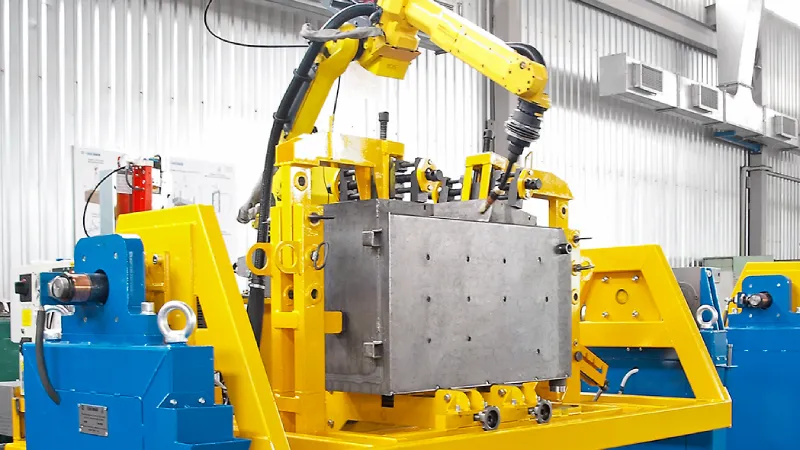
Robotic welding: 7 factors that decide whether the project pays off A robot doesn't fix bad fixturing, skip training, or replace maintenance. Here's what to plan for before you invest in a robotic welding cell.
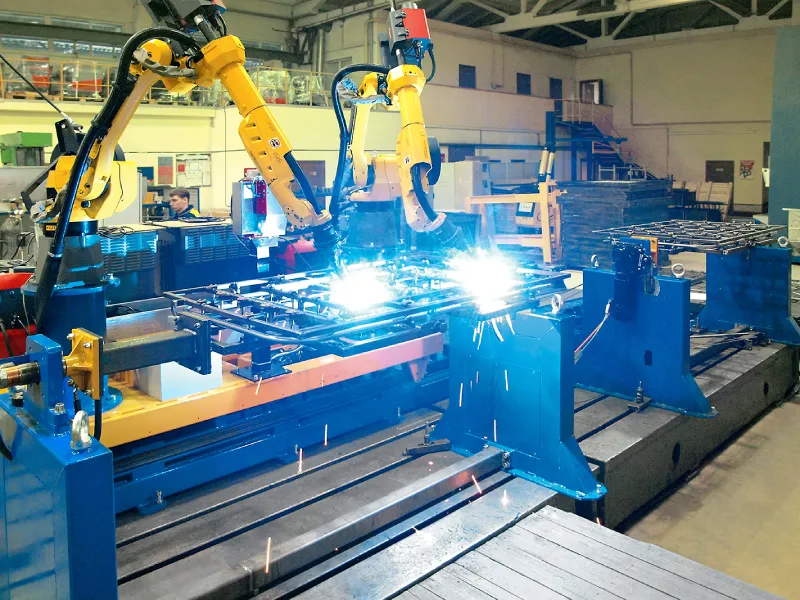
Robotic welding is no longer an experiment reserved for market leaders — it's a working tool that pays for itself through higher output, lower material costs, and reduced dependence on scarce skilled labor. Below are 10 concrete reasons manufacturers are moving welding operations onto robotic welding cells (RWCs), and how each one shows up on the production floor and the balance sheet.
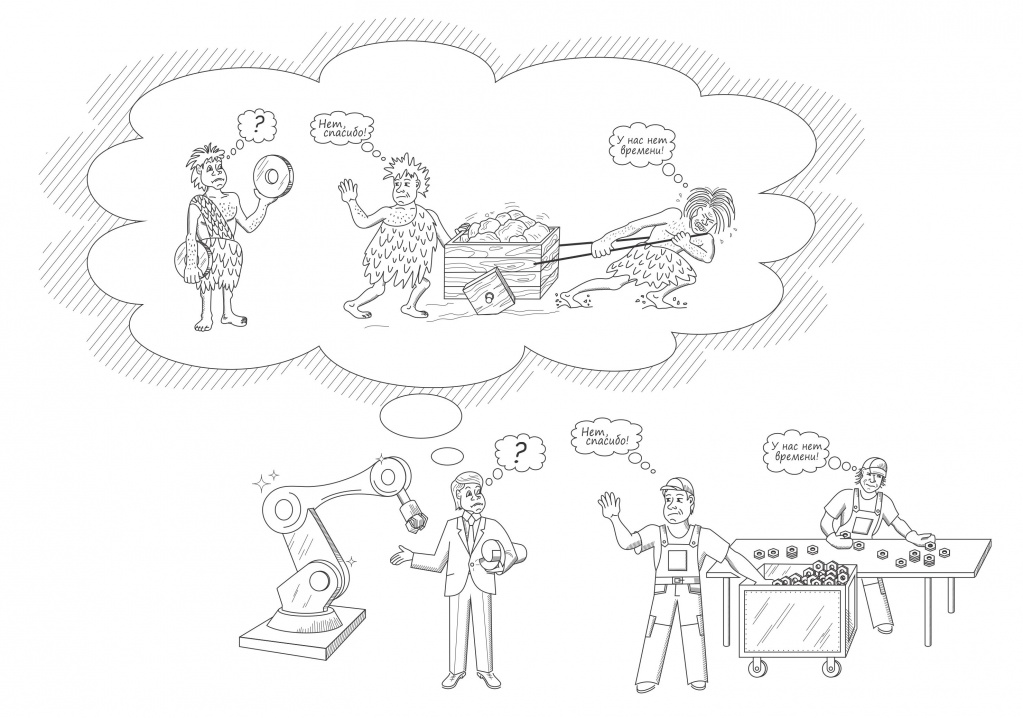
There is a persistent stereotype in the post-Soviet machine-building industry that industrial robots are expensive equipment that requires highly professional personnel and that it is rational to use them in mass or high-volume production. This myth is based on some factors listed below.