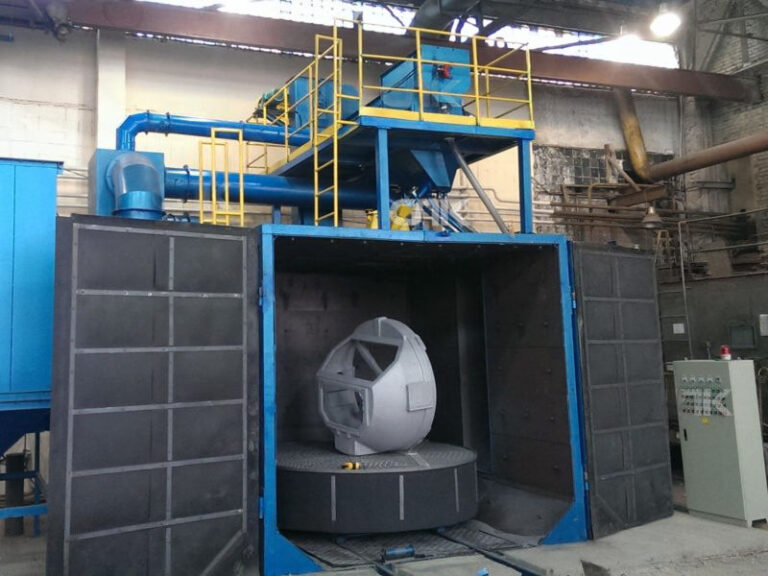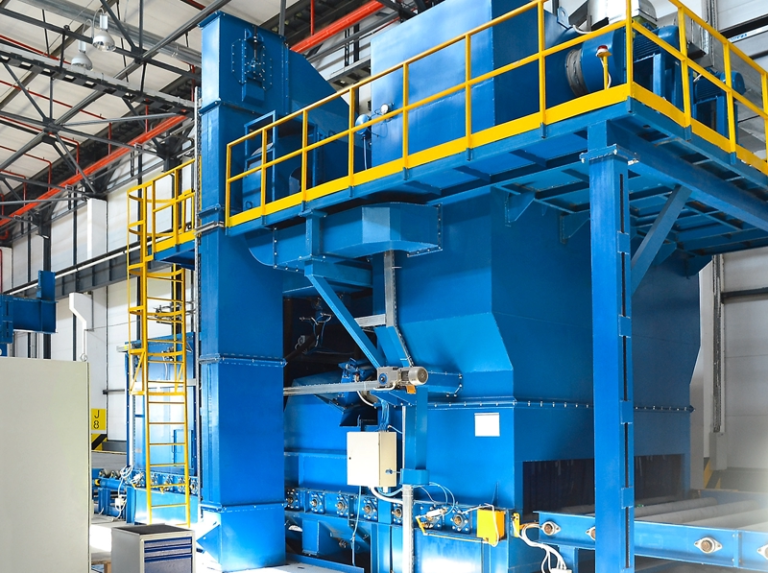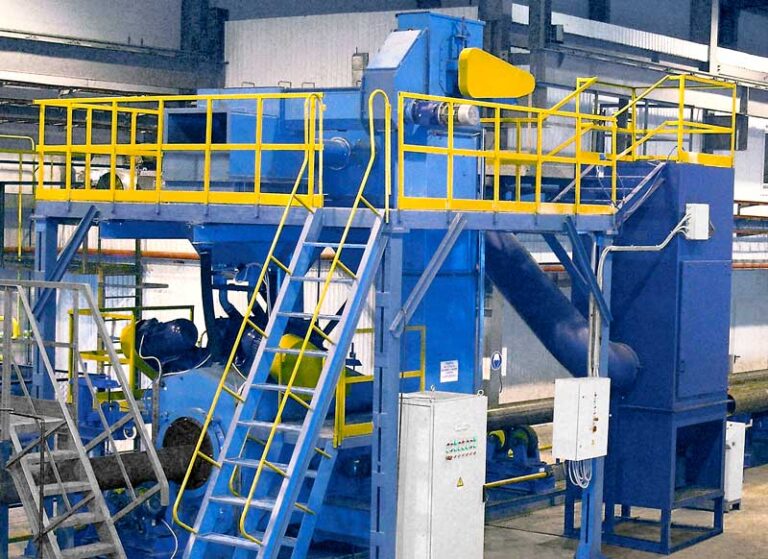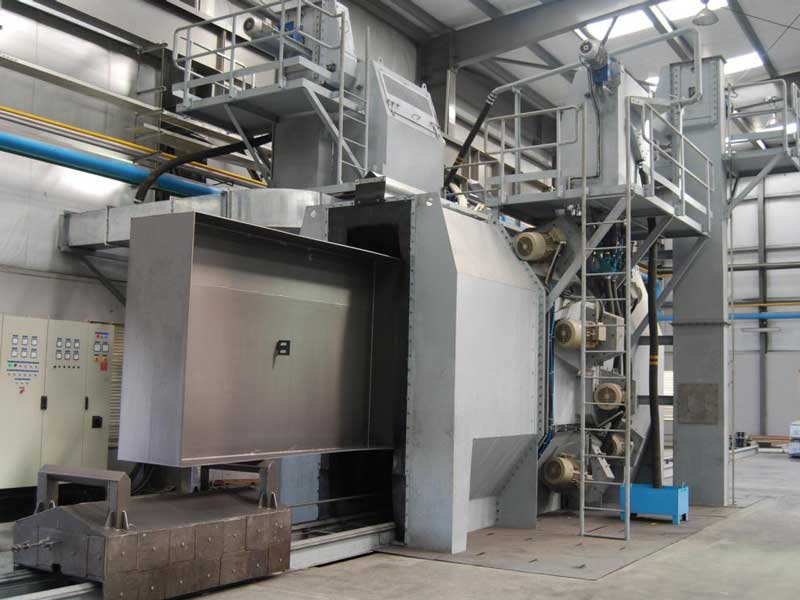
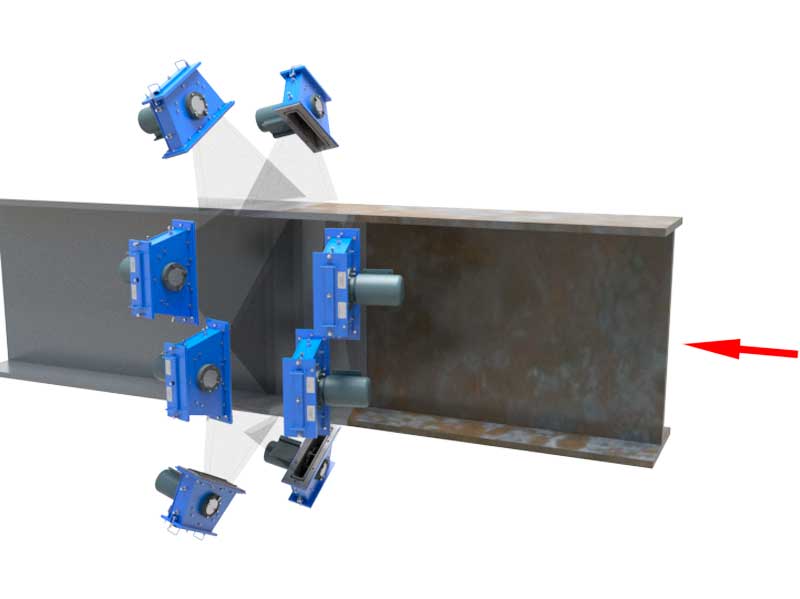
The chamber is designed for shot blasting of welded metalware (up to the 2nd purification degree acc. to GOST 9.402-80 PSA2½ ISO 8501-2 in stationary conditions).
The feed of metalware through the shot-blasting chamber can be carried out down a roller table or on a carriage (the carriage consists of two interconnected sections). Location of the shot-blasters allows ensuring the cleaning of complex metal structures from all sides. This also ensures the cleaning of the end surfaces, stiffeners, welds.
Application
- Shot blasting from scale, rust of non-standard large metalware;
- Shot-blasting plant is perfectly suitable for cleaning of construction metalware: I-beams, bridge beams, etc.
- A perfect solution for surface preparation before painting.
Operation principle
The workpieces are loaded onto a carriage (or roller table)with the help of a workshop crane and fed through a shot-blasting chamber.
The drives of the shot-blasting machines are turned on and the metal structures are cleaned with shot.
Location of the shot-blasting machines (two zones) allows for complete cleaning of the items (including end surfaces, stiffeners, welds).
Each zone consists of shotblasters located on the upper and lower parts of the shot-blasting chamber, as well as on the side walls. The shot-blasting machine of the primary zone is installed transversely and with an inclination towards the flow of the item. The shot-blasting machine of the second zone is similar to the first one, but with an inclination in the opposite direction. This creates a stream of shot allowing to cover the entire surface of the metal structure.
Specifications
Base configuration and project-specific range
| Parameter | Base model | Range for custom projects | |
|---|---|---|---|
| 1. | Dimensions of work-pieces to be cleaned, mm: | ||
| Length of work-pieces, mm | min 6000 | up to 16,000 and more | |
| Width of work-pieces, mm | 1000 | up to 4000 | |
| Height of work-pieces, mm | 1800 | up to 2500 | |
| 2. | Move speed of work-pieces, m/min | 1-1,2 | up to 3 (per process requirements) |
| 3. | Microasperity height of treated surfaceсу, µm | 40-80 | 40–80 |
| 4. | Quantity of shot-blasters | 12 | 8 to 24 |
| 5. | Adjusted power, kW | 160 | 110–320 |
| 6. | Air suction volume, m³/h | 48000 | calculated individually |
| 7. | Overall dimensions of the unit (L×W×H), mm | 8500×7000×6800 | per project |
| 8. | Pit depth, mm | 1350 | per project |
| 9. | Chamber weight, t | 46 | per project |
Technical Options for Equipment
1. Air Cleaning and Filtration Systems
- Cartridge filters, cyclones — reduce dust concentration in the workshop and extend service intervals for the main equipment.
- Aspiration systems with automatic filter regeneration — maintain stable exhaust performance without stopping the line for manual filter cleaning, reducing downtime.
2. Additional Chamber Protection
- Additional chamber protection kit (manganese steel) — extends the service life of the chamber body in high-wear zones and reduces the frequency of major repairs.
3. Automation and Control
- Integration into the plant’s control system — allows the chamber to operate as part of a unified production loop, synchronized automatically with loading and downstream operations such as painting or assembly.
- Diagnostics and remote monitoring — shortens response time to faults and enables maintenance planning based on actual component condition rather than a fixed schedule.
4. Loading Systems
- Infeed and receiving roller conveyors — speed up the loading/unloading cycle and reduce reliance on the workshop crane for every operation.
- Cross-loading tables — simplify redirecting the workpiece flow between several processing stations.
- Manipulators or lifts for loading large parts — reduce strain on personnel and the risk of damaging workpieces during manual loading.
5. Sorting and Quality Control
- Video cameras and surface cleanliness monitoring sensors — provide documented confirmation of the achieved cleanliness degree before the item is handed off for painting, which is particularly important under contracts with fixed coating requirements.
6. Sound and Vibration Insulation
- Additional soundproofing enclosures — bring workshop noise levels down to occupational safety norms.
- Damping mounts or vibration isolators — reduce vibration transfer to the foundation and adjacent production areas.
Service and Design Options
1. Custom Configurations and Custom Projects
Development of custom solutions for specific products and integration into the customer’s production line — from calculating the number of shot-blasters to designing the pit and aspiration systems for a specific workshop.
2. Commissioning and Personnel Training
Supervision of installation and commissioning at sites in Ukraine and abroad, with operator training on-site or remotely.
3. Consumables and Spare Parts
In stock, delivered on schedule — avoiding downtime while waiting for components.
4. Service
Service contracts (warranty and post-warranty service), equipment condition audit, and scheduled maintenance.
Frequently Asked Questions
The service package includes:
- our specialist's presence during equipment installation by the client's representatives for a specified period of time;
- organization and supervision of the installation process;
- commissioning and configuration of equipment parameters.
Articles
- Shot blasting equipment: purpose, types, characteristics
- Overview of popular shot blasting equipment models
- Removal of abrasive residue and dust after shot blasting | Surface preparation for painting
- Evaluation of dust content of steel surfaces before painting – ISO 8502-3
- Preservation lines: shot blasting and painting in one solution