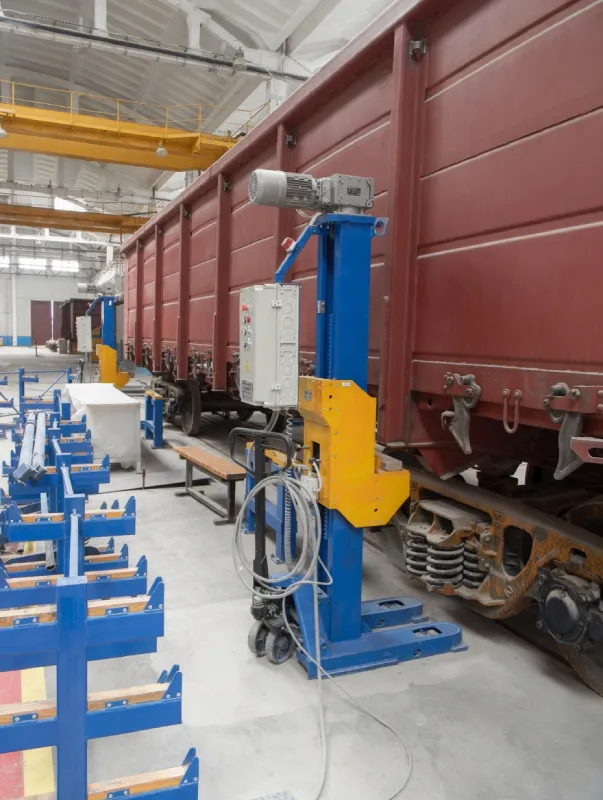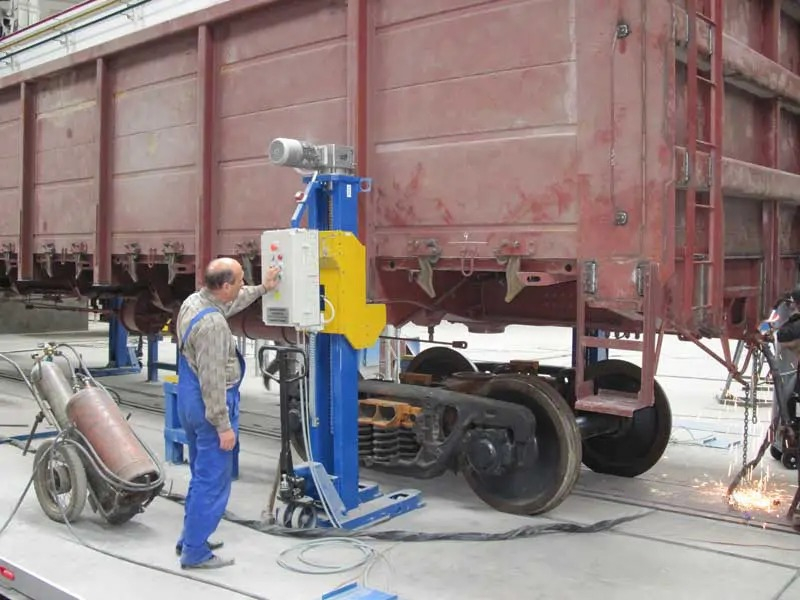
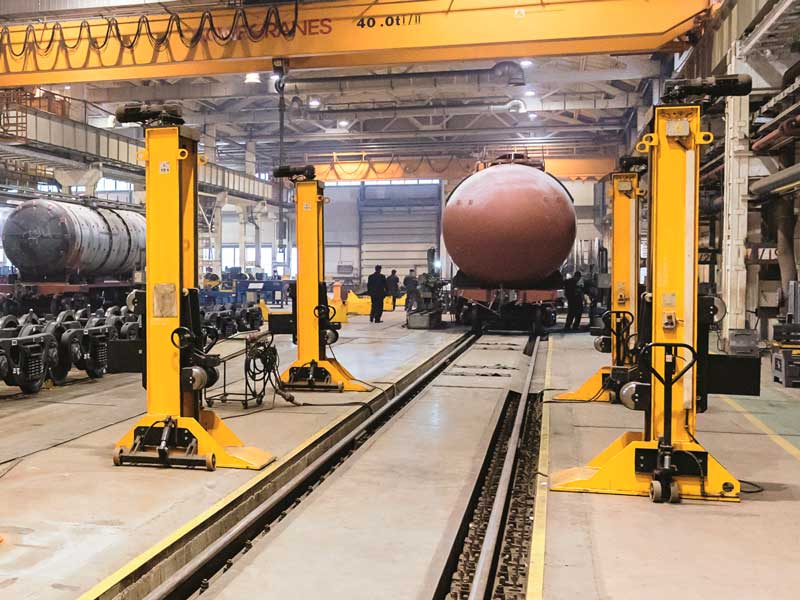
Techvagonmash designs and manufactures synchronized railway lifting jacks for gondola car, hopper car, tank car, metro car, locomotives and tram production lines. Four standard models cover total lifting capacities from 28 to 180 tonnes, with full synchronization of all drive units controlled from a single panel. The equipment operates on a flat concrete surface without fixed foundation works — making installation and relocation straightforward at any assembly facility.
How the Lifting Jack System Works
Each installation consists of four independent electromechanical columns connected to a shared control unit. When the operator initiates a lift, the PLC synchronizes all four drives within a tolerance that prevents uneven loading of the wagon body. The lifting and lowering cycle is accompanied by light and audible alarms; the raised position is indicated by an intermittent warning on the light column mounted on each post.
The load-carrying spindle uses a screw-nut mechanism with inherent self-locking: the load cannot descend under its own weight if power is lost, eliminating the need for separate mechanical locking devices during maintenance operations.
All columns travel on polyurethane-coated wheels running on rolling bearings. A single operator can reposition the entire four-post set without additional lifting equipment or assistance.
Technical Specifications:
| Parameter | Model LJ-28 | Model LJ-60 | Model LJ-120 | Model LJ-180 |
| Total load capacity, kg | 28000 | 60000 | 120000 | 180000 |
| Post load capacity(max.), kg | 7000 | 15000 | 30000 | 45000 |
| Body lifting height, mm | 1700 | 1700 | 1700 | 1700 |
| Lifting speed, m/min | 0,25 | 0,25 | 0,25 | 0,25 |
| Drive power per post, kW | 1,5х4 | 3х4 | 5,5х4 | 7,5х4 |
| Total installed capacity, kW | 6 | 12 | 22 | 30 |
| Drive type | Electromechanical | |||
| Control panels | 4 | 4 | 4 | 4 |
Custom configurations — lifting height, capacity, RAL colour — available on request.
Key Features and Advantages
Full synchronization of all lifting drives All four columns operate as a coordinated unit. The control system continuously equalizes lift height across posts throughout the entire stroke, protecting the wagon body from uneven loading and frame distortion during assembly operations.
Control from any of four panels The operator can initiate and supervise lifting from whichever panel provides the best sightline to the work area. Control panels can be repositioned along the wagon without stopping the process.
Electromechanical self-locking drive The screw-nut drive locks mechanically under load. There is no hydraulic pressure to maintain and no risk of gradual settlement during extended assembly or welding operations — the wagon stays at the set height without active power consumption.
Mobility without foundation works Polyurethane wheels on rolling bearings allow a single operator to move each column with minimal effort. No floor channels, no pits, no anchor bolts — the system adapts to changes in line layout or facility reconfiguration.
Light and sound signalling at every stage Each phase of the lift cycle — start, intermediate travel, raised position, descent — is distinguished by a dedicated signal pattern on the light column, providing clear status confirmation across noisy workshop environments.
Low installed capacity Total connected power ranges from 6 kW (LJ-28) to 30 kW (LJ-180), significantly below comparable hydraulic systems of the same capacity.
Applications
Tekhvagonmash lifting jacks are used at the following stages of railway rolling stock production and maintenance:
- Manufacturing of freight and passenger cars – lifting car bodies for assembling the chassis, installing bogies and welding the floor.
- MRO (maintenance and repair) workshops — bogie removal, wheelset inspection, brake gear replacement without dedicated pits.
The four-column arrangement is suitable for standard wagon lengths; multi-unit configurations (6 or 8 columns) can be supplied for articulated rolling stock or locomotives on request.
Request a price quote
Options and Configurations
The standard range covers four lifting capacities. The following options are available on request — please specify in your technical requirements.
Configuration and Capacity
Extended multi-column configuration (6, 8, 12+ columns) Two or more control units linked into a single synchronised system. Used for articulated rolling stock, long locomotive bodies, or simultaneous lifting of multiple units at one assembly station.
Non-standard lifting capacity Intermediate models — 32, 40, 48, 80 t total capacity and other values — are manufactured to match specific wagon tare weights, avoiding unnecessary over-specification.
Increased lifting height Stroke from 1 700 mm up to 2 500 mm and above — for wagons with a high frame, for work under tall underframe equipment, or where operators need free access beneath the raised body.
Variable lifting speed (VFD) A frequency converter on each drive provides smooth acceleration and deceleration. Recommended for aluminium and stainless-steel metro and tram car bodies where dynamic shock loads at cycle start/stop are undesirable.
Control and Automation
Wi-Fi / wireless remote control Computerised control unit with a wireless hand-held pendant. The operator manages the lift cycle from any point in the workshop without being tied to the cable-connected column panels. Includes event logging and parameter recording.
Touchscreen HMI panel (10″–21″) Central operator panel with a touchscreen display instead of pushbutton controls. Shows real-time column height and status, event log, and fault messages with diagnostic codes.
Individual column control An on-board control unit on each column for independent movement of a single post — used for offset lifting, balancing a body with an asymmetric centre of gravity, or maintenance on one column while the others remain stationary.
Remote diagnostics and maintenance reminders Export of lift cycle data, load readings, and emergency stop events. Programmable scheduled-maintenance alerts. Remote connection for factory service engineers without a site visit.
Safety
Collision sensors on every column Sensors detect floor obstacles during lowering and stop column travel before contact. Prevents damage to the column, floor-mounted equipment, and personnel when manoeuvring in confined spaces.
Overload monitoring system Load cells on each column with cycle lockout when the rated capacity is exceeded. Protects the drive mechanism and prevents dangerous body tilt under asymmetric load distribution.
Light curtains / work zone guarding Infrared light curtains around the perimeter or physical guarding with interlocks — the cycle stops automatically if the boundary is crossed and only resumes after deliberate operator confirmation.
Adapters and Tooling
Interchangeable lifting adapters Dedicated saddles for specific pick-up points: bogie frame, side sill, tank car barrel, metro car sill. Horizontal adjustment under load — no column repositioning required.
Floor guide rails for repeatable positioning Floor-mounted guides with locating stops for fast, repeatable column placement in series production. Eliminates floor marking before each lift cycle.
Motorised travel drive An integral gear motor on the running gear of each column for powered repositioning around the workshop. Removes manual effort when relocating heavy LJ-120 and LJ-180 columns.
Execution
Explosion-proof execution (ATEX / IECEx) Ex-classified electrical equipment for use in zones with flammable gases or vapours — painting, priming, and maintenance areas where solvent-based coatings are applied.
Climate execution (cold-climate / tropical) Extended operating temperature range for unheated workshops (down to −40 °C) or tropical environments: special lubricants, heated control enclosures, elevated IP-class seals.
RAL colour finish Structural members and covers painted to a specified RAL colour — for zone identification, corporate colour standards, or application of safety warning markings.
Service
Installation supervision and commissioning Factory specialists on-site: installation oversight, acceptance testing, commissioning documentation, and operator training at the customer’s facility.
Extended service contract Annual or multi-year maintenance: scheduled inspections, priority callout for breakdowns, spare parts held at the supplier’s warehouse. Minimises production line downtime.
First-line spare parts kit Supplied with the equipment: wear parts, safety nuts, polyurethane wheels, and consumables for scheduled maintenance. Reduces recovery time at first failure without waiting for a parts order.
Documentation in the customer’s language Full set of operating manuals, equipment passports, and electrical drawings in Russian, Ukrainian, English, or another agreed language.
Discover real-world examples of how Techvagonmash synchronized electromechanical lifting jacks have helped railway enterprises improve safety, efficiency, and productivity.
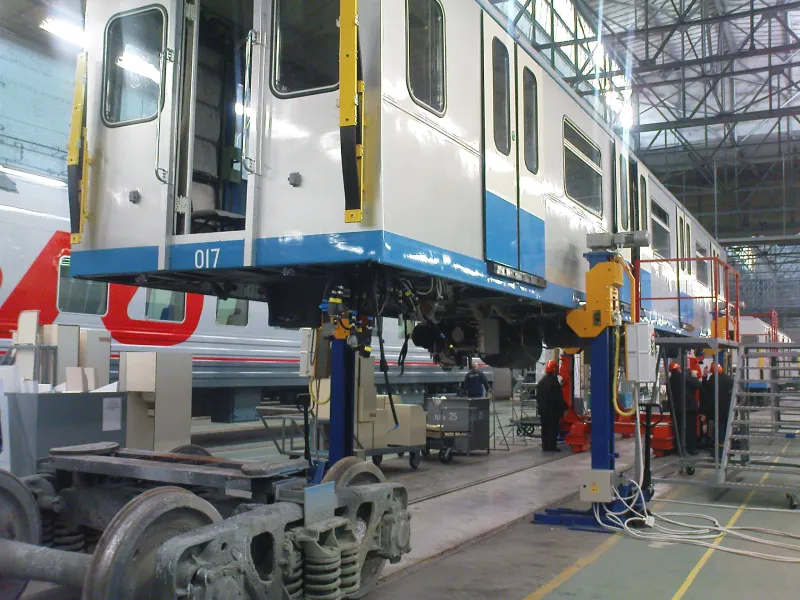
Subway car manufacturing plant
Challenge: Modernization of the plant for the production of metro cars. The customer needed to replace outdated hydraulic jacks with a safer, more mobile solution that did not require expensive foundation construction.
Solution: Supply and installation of a mobile synchronized lifting system with 28-ton capacity (4 jacks + centralized control system). The equipment was installed in the existing workshop without production downtime.
Results:
- 45% reduction in wagon lifting/lowering time.
- Synchronization accuracy of ±2 mm.
- Complete elimination of oil leak risks thanks to the electromechanical drive.
- Over 60% reduction in maintenance costs compared to hydraulic systems.
Freight Wagon Manufacturing Plant, Kazakhstan
Challenge: Equipping a new assembly line for gondola wagons with modern lifting equipment for bogie installation.
Solution: Installation of a stationary-mobile lifting complex with total capacity of 32 tons, supporting both synchronous and individual operating modes. Full integration with the plant’s existing workshop management system.