Contents
How does a shot blasting machine work
Types of shot blasting equipment
Shot blasting vs. sandblasting: what is the difference?
What type of shot is used for shot blasting
How to choose a shot blasting machine
Typical mistakes when choosing shot blasting equipment
Why companies choose Techvagonmash shot blasting equipment
What is shot blasting?
Shot blasting is a high-performance method of mechanical cleaning of metal surfaces using metallic shot, which is accelerated to high speeds by special turbine (shot blasting) wheels. As a result of the abrasive impact, rust, scale, casting residue, old paint, contaminants, and other defects are removed from the surface.
Today, shot blasting is considered one of the most effective surface preparation technologies before painting, welding, applying protective coatings, galvanizing, and other manufacturing operations. Thanks to its high productivity and stable cleaning quality, it is widely used in mechanical engineering, railcar manufacturing, metallurgy, shipbuilding, metal structure production, and many other industrial sectors.
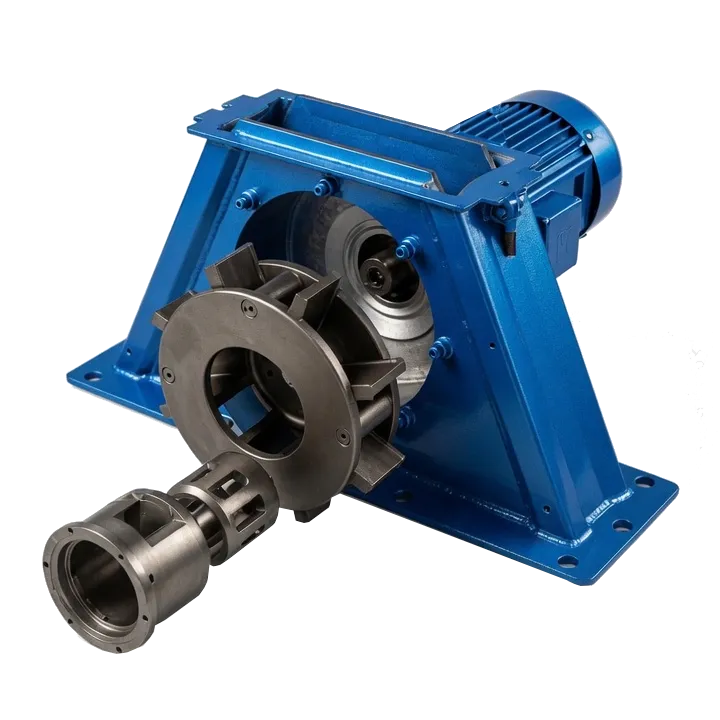
Unlike manual cleaning or sandblasting, where the abrasive is supplied by compressed air, shot blasting machines use powerful turbine wheels, which significantly increases productivity and reduces the cost of processing.
How does a shot blasting machine work
The operating principle of a shot blasting machine is based on transferring kinetic energy to the metallic shot.
The cleaning process includes several sequential stages:
- The workpiece enters the work chamber.
- Shot blasting turbines accelerate the metallic shot to a speed of 60–110 m/s.
- The shot stream impacts the surface of the product, removing contaminants and creating the required roughness.
- Spent shot is collected by the conveying system.
- The separator cleans the abrasive from dust and contaminants.
- Cleaned shot is fed back into the turbines.
- The dust collection system removes fine particles and maintains cleanliness inside the work chamber.
This closed-loop cycle ensures minimal abrasive consumption, stable processing quality, and high cost-effectiveness.
Types of shot blasting equipment
The choice of equipment depends on the dimensions of the products, the plant’s production capacity, and technological requirements.
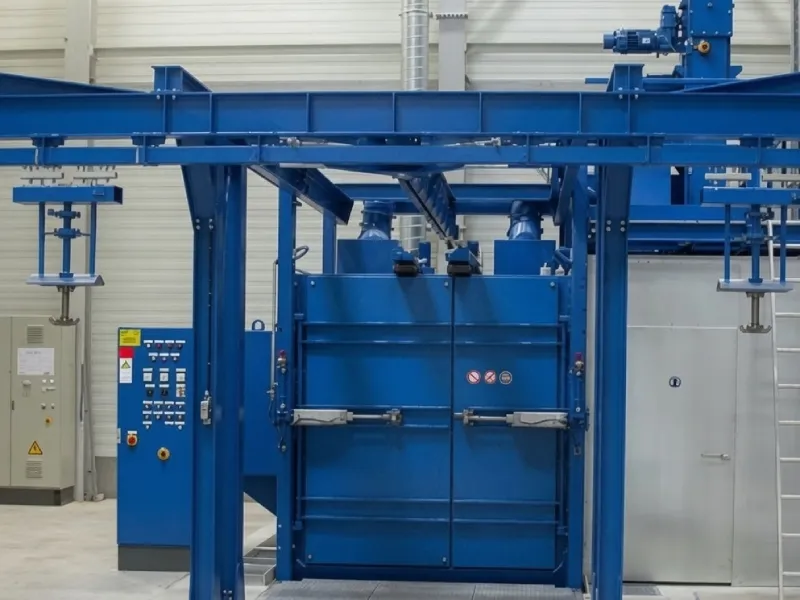
Hanger-type shot blasting machines
Designed for cleaning complex welded structures, frames, machine parts, and products that are conveniently transported on an overhead conveyor. During processing, the product rotates, ensuring uniform exposure to the shot stream.
Advantages:
- Processing of complex-shaped products;
- High productivity;
- Automation capabilities;
- Uniform cleaning of all surfaces.
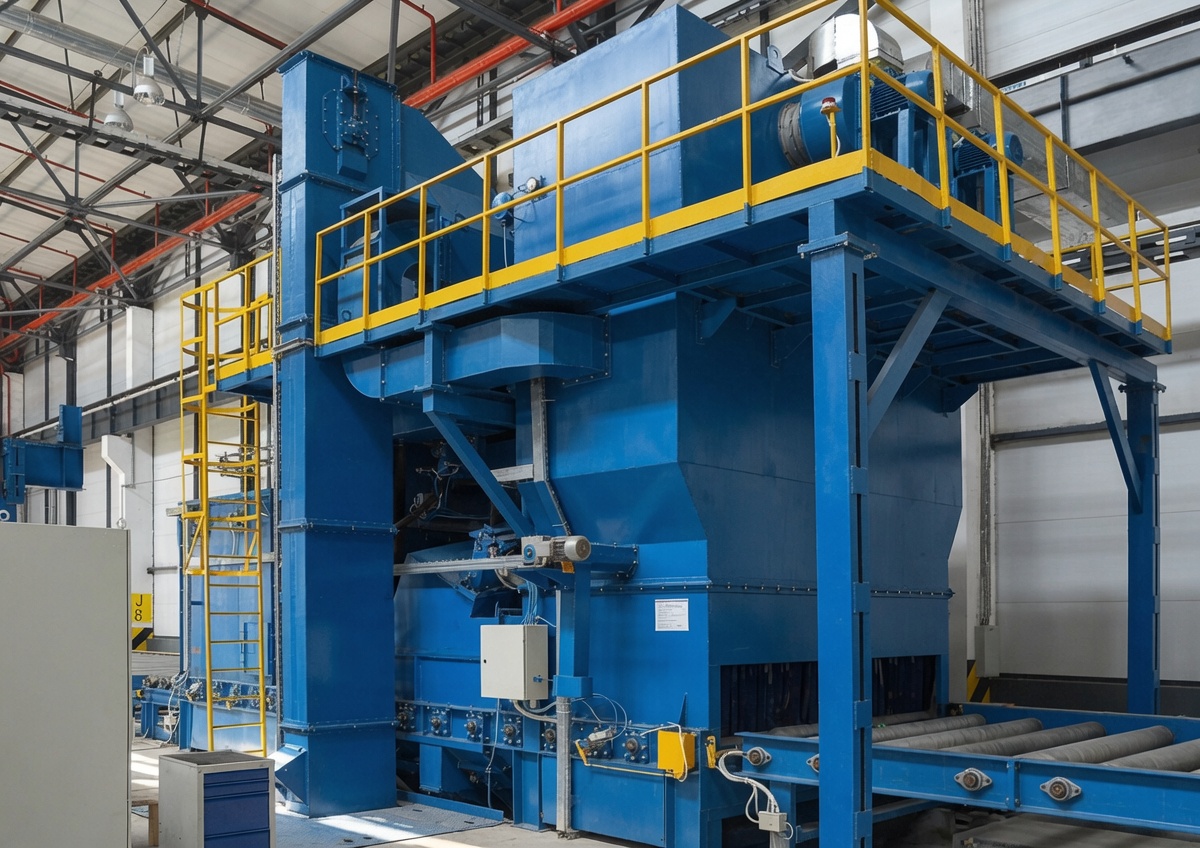
Roller conveyor shot blast machines
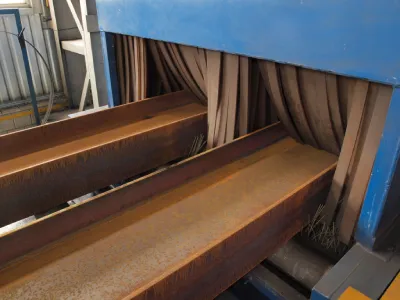
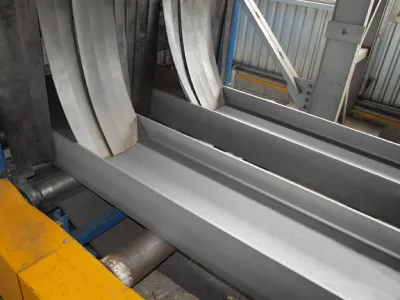
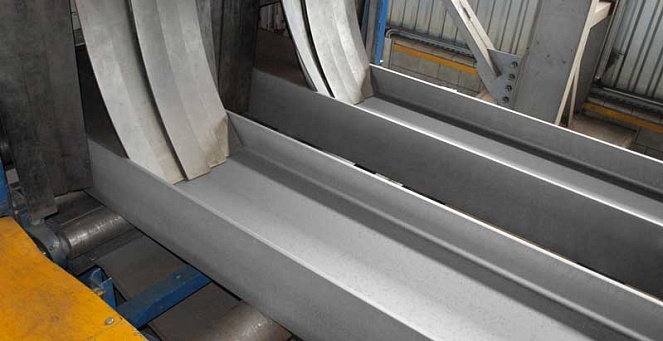
Used for processing sheet metal, beams, profiles, pipes, and other long products. The workpiece continuously passes through the work chamber, ensuring high productivity and easy integration into production lines.
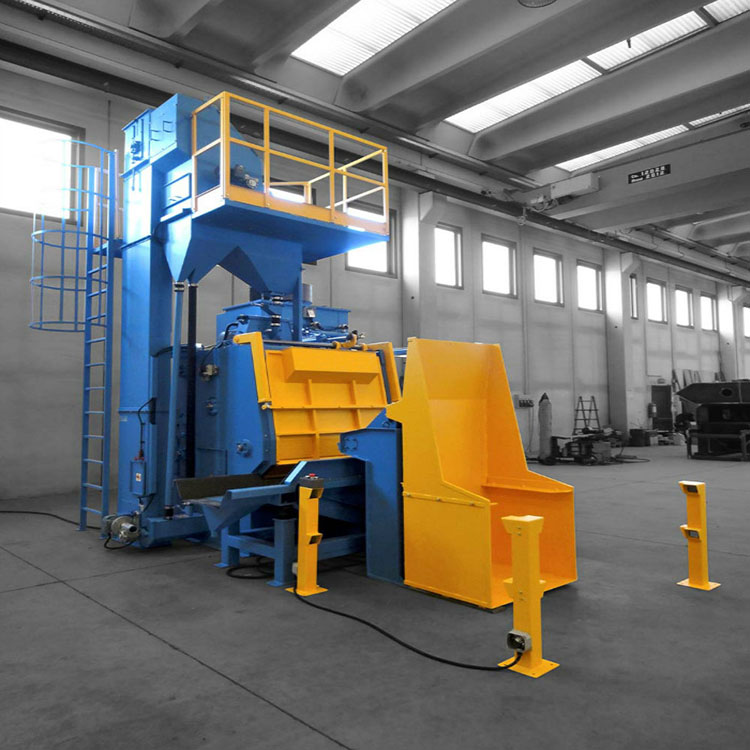
Tumble-blast (barrel) shot blasting machines
This equipment is designed for cleaning, peening, and surface preparation of small and medium-sized metal parts. Processing takes place in a rotating barrel, inside which the parts are moved and evenly treated by the shot stream accelerated by shot blasting turbines.
Such machines are widely used in mechanical engineering, foundry, and metalworking to remove scale, rust, burrs, and other contaminants. Their key advantages are high productivity, uniformity of processing, and the ability to automate the process.
Tumble-blast machines are especially effective for serial processing of large quantities of small parts, providing stable surface quality at relatively low operating costs.
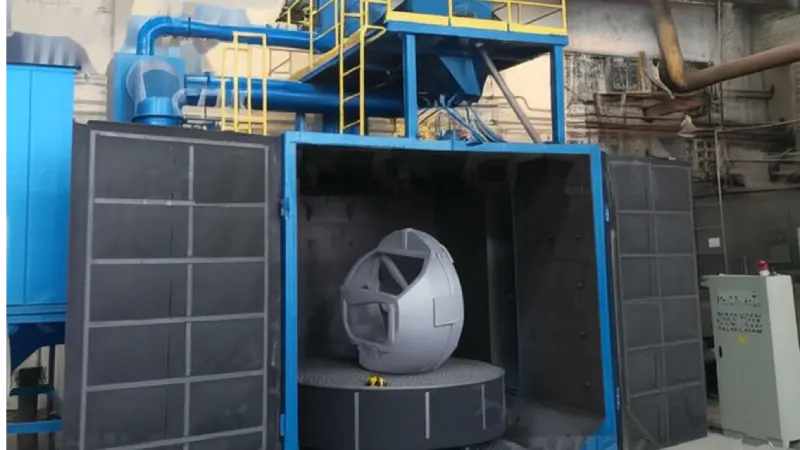
Shot blasting machines with a turntable
Shot blasting machines with a turntable are designed for efficient cleaning, removal of scale and rust, and surface preparation of metal parts before painting, coating, or welding. The workpieces are placed on a rotating table, ensuring uniform exposure to the metallic shot stream from all sides without the need for manual turning.
Such equipment is optimal for processing complex-shaped parts, castings, forgings, welded structures, gearbox housings, automotive components, and other medium- and heavy-weight products. The cabinets feature high productivity, stable cleaning quality, and full automation capabilities.
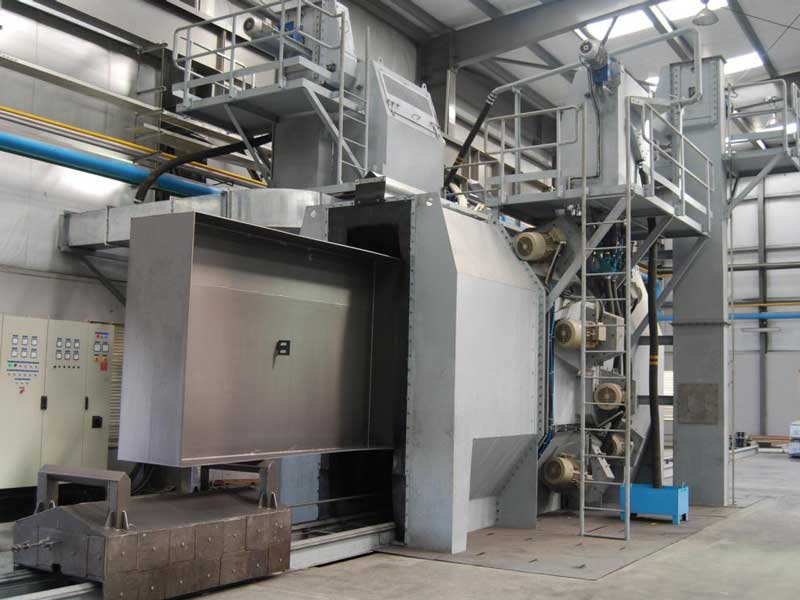
Shot blasting machines (custom design)
Such machines are custom-designed to meet the customer’s specific requirements and may accommodate non-standard product dimensions, special operating conditions, increased work intensity, or specific material requirements.
Custom designs often include reinforced internal lining to protect against abrasive wear, expanded abrasive recovery and cleaning systems, a higher degree of automation, and integration into existing production lines. This ensures stable processing quality and high productivity even in complex manufacturing environments.
Shot blasting vs. sandblasting: what is the difference?
Despite the similarity in names, shot blasting and sandblasting differ significantly in operating principle, productivity, and application areas. The choice of technology depends on product size, required throughput, part configuration, and operating conditions.
| Parameter | Shot Blasting | Sandblasting |
|---|---|---|
| Abrasive acceleration principle | Turbine wheel | Compressed air |
| Productivity | Very high | Medium |
| Automation | Fully automated | Mostly manual or semi-automatic |
| Cost-effectiveness | High for serial production | Optimal for small volumes |
| Energy consumption | Lower when processing large batches | Higher due to compressor operation |
| Abrasive consumption | Minimal due to closed-loop cycle | Depends on recovery system |
| Product size | From small parts to large structures | Virtually unlimited |
| Type of production | Serial and mass production | Repair, single-piece, and universal |
When is it better to choose shot blasting
Shot blasting machines are most effective when the plant:
- Produces large batches of products;
- Has a flow production line;
- Regularly cleans metal structures, beams, pipes, sheet metal, castings, or welded assemblies;
- Aims to reduce processing costs;
- Plans to automate the production process.
When is sandblasting preferred
Sandblasting technology is suitable for:
- Repair of large structures at the site of operation;
- Processing of complex-geometry parts that cannot be accessed in an automatic machine;
- Small production volumes;
- Local removal of corrosion and old coatings.
In many cases, plants use both technologies: shot blasting machines for serial processing and sandblasting cabinets for non-standard or repair work.
What type of shot is used for shot blasting
Processing quality depends not only on the equipment but also on the correctly selected abrasive. The most common types of metallic shot are as follows.
Cast steel shot
The most versatile material for cleaning metal structures, rolled metal, pipes, and welded products.
Advantages:
- Long service life;
- High impact strength;
- Uniform surface cleaning;
- Minimal dust generation.
Used in most automatic shot blasting machines.

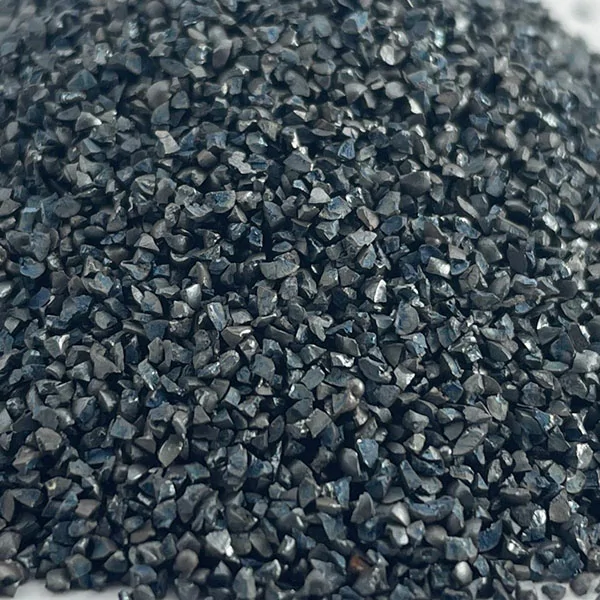
Steel grit
Has an angular shape and provides a more aggressive impact.
Recommended for:
- Removing thick layers of scale;
- Cleaning heavily corroded surfaces;
- Preparing metal for coatings with high adhesion requirements.
Stainless steel shot
Used for processing stainless steel, aluminum, and non-ferrous metal products.
Key advantages:
- No contamination of the surface with carbon steel particles;
- High corrosion resistance;
- Possibility of reuse.

Special types of abrasives
In some cases, the following are used:
- Glass beads;
- Ceramic shot;
- Aluminum shot;
- Zinc alloy shot.
The choice depends on the product material, required surface roughness, and process specifics.
Surface preparation standards
After shot blasting, cleaning quality is assessed according to international standards. The most common is ISO 8501-1, which defines the degree of surface preparation before applying protective coatings.
Sa 1 — Light cleaning
Loose rust, scale, and contaminants are removed. Dense traces of corrosion may remain on the surface.
Rarely used and generally only for structures with low coating durability requirements.

Sa 2 — Thorough cleaning
The surface is cleaned almost completely. Only slight traces of firmly adherent contaminants are allowed.
Used for the manufacture of most industrial structures.

Sa 2½ — Very thorough cleaning
The most sought-after level of surface preparation in industry.
After processing:
- No scale or rust remains;
- Old coatings are removed;
- The surface acquires a uniform metallic color;
- High adhesion of paint and coating materials is ensured.
Grade Sa 2½ is most often required for the manufacture of railcars, bridge structures, tanks, equipment, and metal structures.

Sa 3 — Cleaning to white metal
The highest degree of surface preparation.
All contaminants and corrosion products are completely removed.
Applied to critical structures operating in particularly aggressive environments.

How to choose a shot blasting machine
When choosing equipment, it is necessary to consider not only the dimensions of the products but also the specifics of the production process.
Productivity
Determine:
- Number of products per shift;
- Product weight;
- Surface area to be cleaned;
- Required processing speed.
This determines the number of turbines, drive power, and work chamber dimensions.
Product dimensions
The work chamber dimensions must allow free positioning of products and effective operation of the shot stream.
Through-feed machines are more often chosen for long products, while shot blasting cabinets are chosen for large structures.
Part configuration
If products have complex shapes, internal cavities, or a large number of welded elements, it is important to ensure their rotation or change of position during processing.
Hanger-type shot blasting machines or special positioners are optimal for such tasks.
Type of production
For mass production, it is advisable to use fully automated lines with roller conveyors, overhead transporters, and automatic loading systems.
For small enterprises, the use of universal shot blasting cabinets is economically justified.
Quality of the air cleaning system
A modern machine must be equipped with an effective aspiration system that ensures:
- Safe working conditions;
- Reduced dust levels;
- Stable equipment operation;
- Compliance with environmental requirements.
Typical mistakes when choosing shot blasting equipment
Practice shows that most problems arise already at the design stage.
The most common mistakes are:
- Choosing equipment without analyzing productivity;
- Insufficient turbine power;
- Using the wrong type of shot;
- Lack of clearance margin in the work chamber;
- Cutting costs on the aspiration system;
- Ignoring maintenance costs;
- Lack of future upgrade potential.
A preliminary technical audit of the production facility helps avoid these mistakes, allowing the selection of equipment that matches both current and future needs of the enterprise.
Why companies choose Techvagonmash shot blasting equipment
The efficiency of shot blasting depends not only on the chosen technology but also on the quality of the equipment, its reliability, and its suitability for the enterprise’s production tasks.
Techvagonmash has been developing and manufacturing industrial equipment for metal surface preparation for over 30 years. During this time, dozens of projects have been implemented for enterprises in the railway, engineering, metallurgical, energy, and construction industries.
When developing equipment, the following factors are taken into account:
- Type and dimensions of workpieces;
- Required productivity;
- Abrasive used;
- Level of production automation;
- Surface cleaning quality requirements;
- Production facility characteristics;
- Environmental standards and industrial safety requirements.
Each project is developed individually, ensuring the selection of equipment that best matches the customer’s technological process.
Advantages of Techvagonmash shot blasting machines
Custom engineering
Standard solutions are not suitable for every enterprise. Therefore, the company’s specialists adapt the equipment to specific production tasks, ensuring the optimal balance of productivity, cleaning quality, and operating costs.
High reliability
The designs incorporate proven engineering solutions built for intensive operation in industrial environments.
Energy efficiency
Modern turbine wheels, optimized shot circulation systems, and effective recovery systems help reduce operating costs and extend equipment service life.
Integrated solutions
The company designs and supplies not only shot blasting machines but also complete surface preparation lines, including:
This approach provides the customer with a fully integrated production solution.
Conclusion
Shot blasting is one of the most effective technologies for preparing metal surfaces before painting, welding, applying protective coatings, and other manufacturing operations. High productivity, stable cleaning quality, automation capabilities, and low operating costs make shot blasting machines the optimal choice for modern industrial enterprises.
Properly selected equipment not only improves product quality but also reduces production costs, extends the service life of protective coatings, and increases overall production efficiency.
If you are planning to purchase a new shot blasting machine, upgrade existing equipment, or select an integrated surface preparation solution, Techvagonmash specialists will help you conduct a technical analysis, select the optimal equipment configuration, and develop a project tailored to your specific production requirements.
Contact our specialists for professional consultation and to select equipment that will ensure maximum productivity and reliability at your facility.
Share:
Related articles
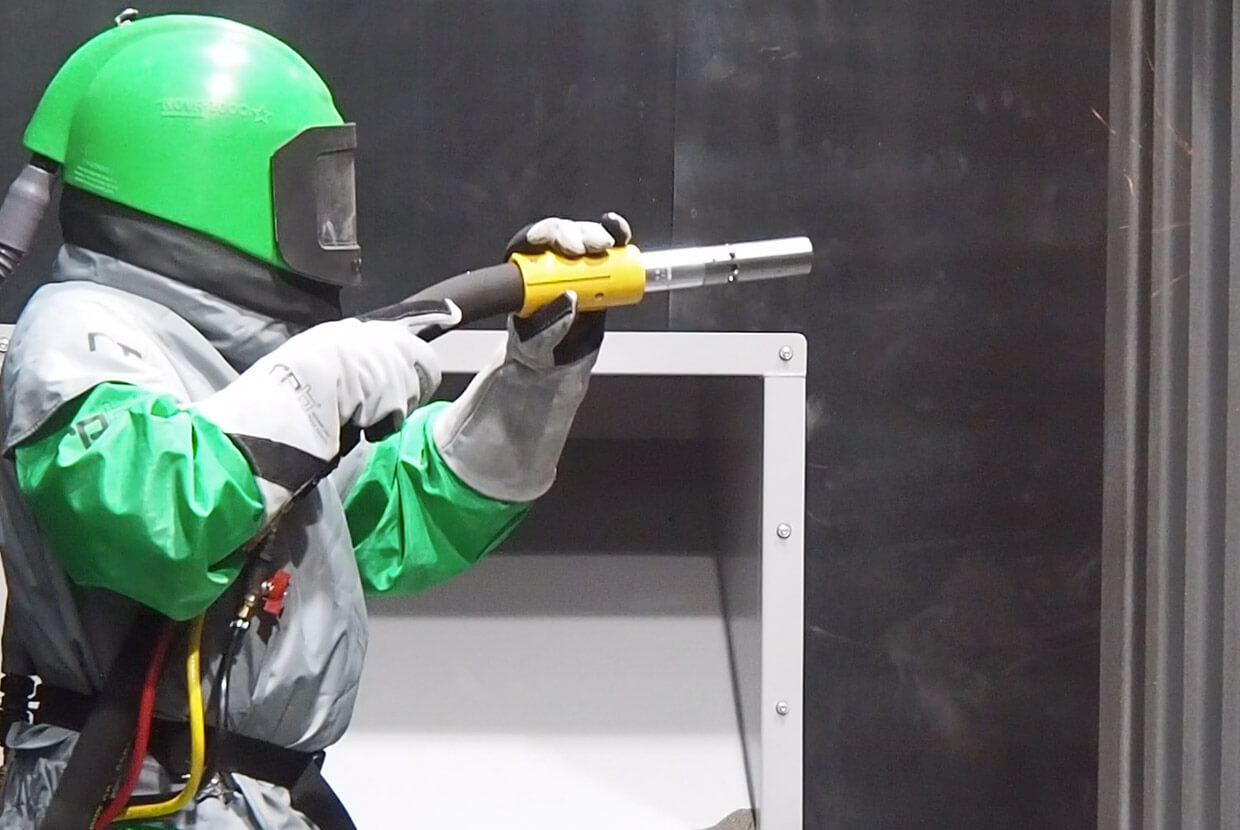
Shot blasting problems are not always caused by poor abrasive quality. In practice, the final cost of the process is shaped by a whole set of factors: working pressure, machine type, separator settings, nozzle wear, and how the abrasive is actually cycled through the system.
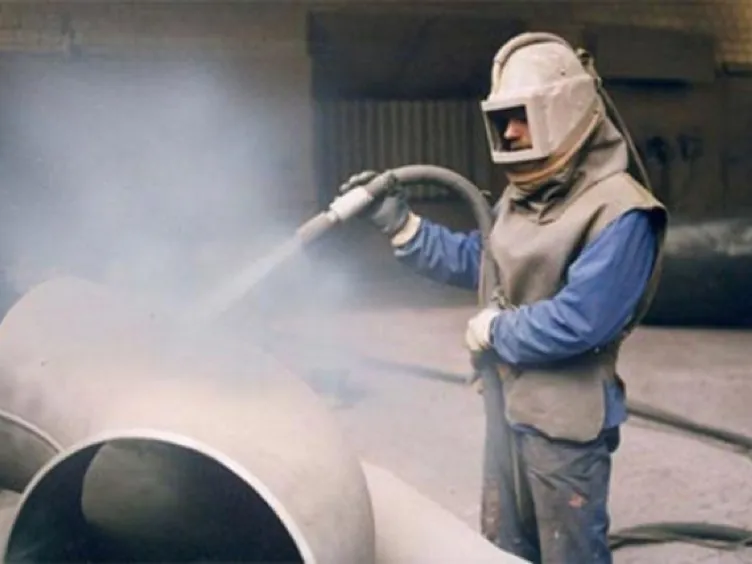
One of the main methods of surface preparation (cleaning and imparting the required roughness) is sandblasting, shot blasting, and wheel blasting treatment. The topic of differences between sandblasting, shot blasting, and wheel blasting technologies is quite relevant. Substitution of these concepts and terms occurs even in professional circles. At the same time, the differences are very significant, and it is simply impossible to ignore them.
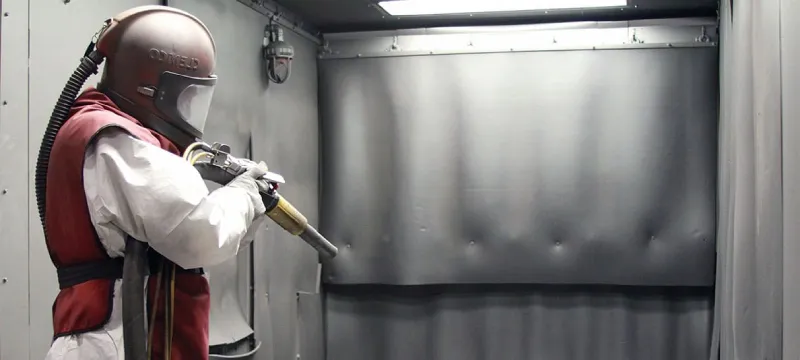
10 practical rules that should be built into the design of shot blasting equipment and into the workshop's operating procedures.
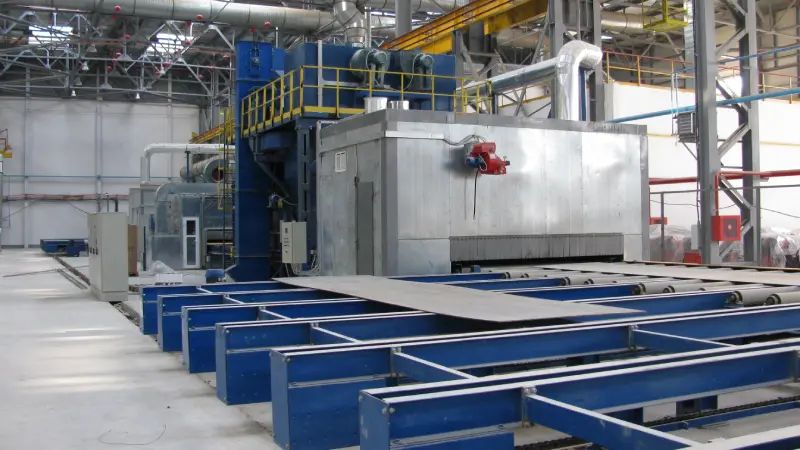
In this article, we will look at the types of transport systems used for shot blasting and painting of rolled metal and welded metal structures.
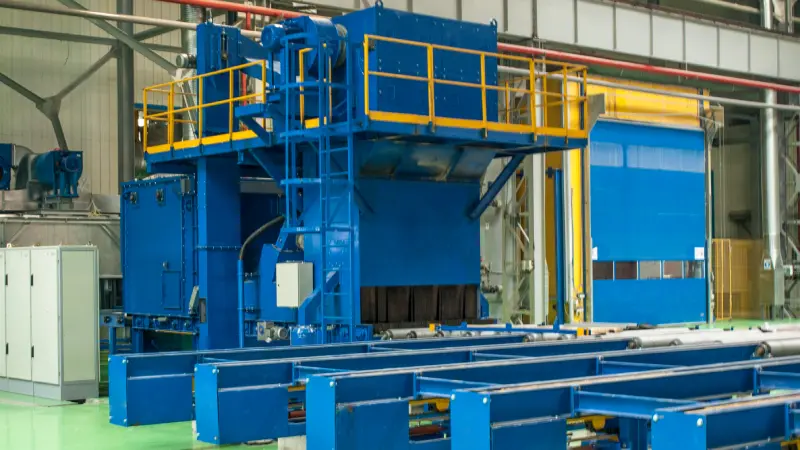
This article discusses the most popular shot blasting machines: a description of their operation and key characteristics.

Learn how to properly clean abrasive residue and dust from metal to ensure reliable surface preparation for painting and extend the service life of steel structures.
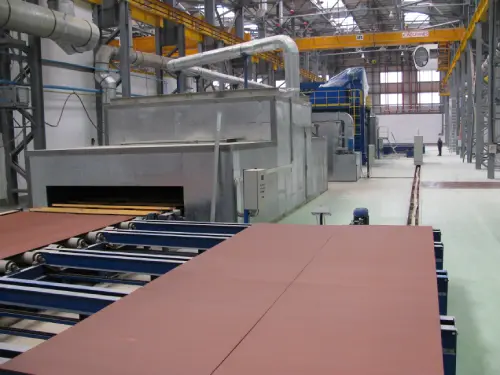
High-quality surface preparation and interoperation protection of rolled metal products are crucial factors in ensuring maximum service life and the highest quality of protective coatings. This preparation can be achieved through shot blasting, followed by the application of a conductive protective primer on the surface of the rolled metal at the stage of its delivery to production.
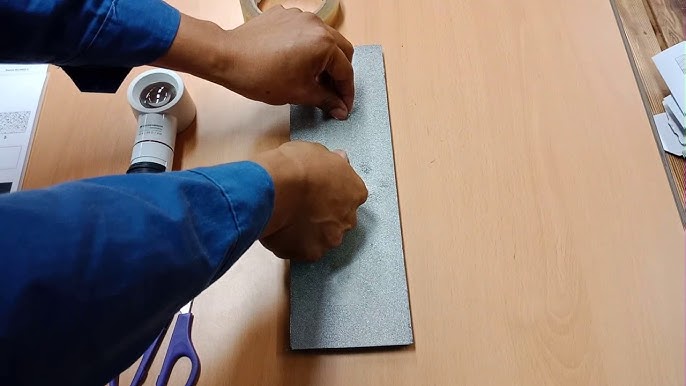
Correct surface preparation is one of the key factors affecting the durability of paint and protective coatings. Measuring the level of dust on steel surfaces before painting helps determine whether additional cleaning and preparation are required.
This article provides a brief description of the types and characteristics of shot blasting equipment.