Table of Contents
- How an automated rack-type warehouse is designed
- Video: the equipment in operation
- Advantages of automated rack-type warehouses
- Rack-type or lift-type warehouse: how to choose
- Technical specifications (sample configuration)
- Custom solutions
- Frequently asked questions
Techvagonmash Company continues to actively develop business in both distant and neighboring export markets. Among its recent large-scale projects is a turnkey production setup at a trailer and towed-equipment manufacturing plant in Samarkand, Uzbekistan. One of the tasks solved as part of this project was the engineering and manufacturing of automated rack-type warehouses.
Rack-type warehouses are designed to store individual loads placed on pallets or cassettes in dedicated storage cells. The maximum permissible load dimensions are 2500×1200×1700 mm. The warehouse operates in automatic mode, with information on stored items entered by barcode scanning or manually.
The concept behind the automated warehouse is built on versatility and multifunctionality. This approach allows off-the-shelf solutions to be adapted to a fairly wide range of specific customer requirements — for example, two-sided loading, storage of individual loads, or integration into a production line.
How an automated rack-type warehouse is designed
Structurally, the warehouse is a single complex made up of four units, all operating under the control of one computer.
- Rack structure — a bolted metal frame made of profiles connected by cross-beams and a bracing system, fitted with cassette supports and finished with exterior cladding panels. This is what determines the warehouse’s storage capacity: the number of rows and cells is calculated individually based on the volume of items to be stored.
- Manipulator — a frame with a drive on the running wheel travels along the rows, while a cross-beam with a lifting drive and extractor feeds a cassette horizontally into and out of a storage cell. A single manipulator can service two retrieval windows at once.
- Receiving table — the point where components are loaded into and unloaded from a cassette, fitted with control scales and cassette-position sensors: exceeding the permissible weight or dimensions automatically blocks the manipulator.
- Retrieval window — the warehouse control panel, photoelectric safety barrier sensors, and a roller shutter. One computer serves two retrieval windows, which reduces automation costs without sacrificing functionality.
The operator manages the warehouse from the on-site computer, and data on product movement is synchronized with the plant’s overall inventory system. Automatic mode is used for day-to-day operation, and manual mode for setup and maintenance.
Video: the equipment in operation
Advantages of automated rack-type warehouses
- Space optimization. Vertical warehouses save up to 90% of floor space, freeing up tens or even hundreds of square meters for storing materials and components as well as for process traffic lanes.
- Time savings. Locating and feeding materials and parts to production is fully automatic — the operator does not need to move around the warehouse.
- Reliable inventory tracking. The system keeps records of the product range, its location, receipt, and issue in chronological order, allowing accurate reporting on stock, write-offs, and receipts.
- Simplified logistics. Eliminates unnecessary material handling and floor-equipment maneuvering between racks.
- Material protection. The enclosed structure shields contents from mechanical damage, dirt, and other harmful factors.
- Protection against unauthorized access. Warehouse control is available only to authorized personnel through an identification system.
- Operator safety. Physical and photoelectric barriers eliminate risk to staff health.
- Simple interface. The control panel requires no special operator training.
- Minimal staffing. A single operator is enough to run the warehouse.
- Higher productivity thanks to a continuous flow of materials and uninterrupted equipment loading.
- Flexible placement. Standalone outdoor installation is possible, as well as placement inside a workshop or right next to operating equipment — with materials fed automatically straight to the machine.
- Climate independence. Full operation in any weather conditions and unfavorable temperatures.
Rack-type or lift-type warehouse: how to choose
Techvagonmash manufactures two types of automated warehouses, and the choice between them depends on a plant’s product range and logistics. The rack-type warehouse described in this article is better suited to storing large loads and pallets with high total storage capacity. If the priority is compactness within limited floor space and fast retrieval of small items, it is worth considering automated lift-type warehouses: they are built differently, with the load moved by a tray traveling vertically inside a closed shaft. Techvagonmash specialists help select the right warehouse type based on the customer’s technical requirements.
Technical specifications (sample configuration)
The parameters of rack-type warehouses are calculated individually for each customer’s task. Below is an example of an implemented automated component-storage warehouse configuration, to give a sense of typical figures:
| Parameter | Value |
|---|---|
| Number of storage rows | 1 |
| Number of manipulators | 1 |
| Number of retrieval windows | 2 |
| Storage volume | 114 m³ |
| Total storage capacity | 58 t |
| Load capacity per cassette | 500 kg |
| Number of cassettes | 116 pcs |
| Internal cassette dimensions | 2450 × 800 mm |
| Cross-beam lift/lower speed | 15.5 m/min |
| Manipulator longitudinal travel speed | 72 m/min |
| Power consumption | 9 kW (380 V, 50 Hz) |
| Warehouse overall dimensions | 19,120 × 3,240 × 8,000 mm |
The exact parameters for your production — number of rows, capacity, cassette dimensions, and speeds — are calculated by Techvagonmash engineers at the design stage and fixed in the technical specification.
Custom solutions
Techvagonmash manufactures automated warehouses not only in standard sizes but also designs projects to the customer’s individual technical requirements. Depending on the task — reconstructing an existing warehouse or building a new one — the project takes into account the product range, production conditions, and other input data.
Building a properly organized warehouse system is now one of the top priorities for many manufacturers worldwide. Storing products, materials, and components in automated warehouses helps avoid space shortages, unreliable storage, inventory errors, and handling difficulties. Equipping a plant with an automated warehouse is a forward-looking, progressive step that saves both money and time.
To have a warehouse configuration calculated for your task, contact Techvagonmash specialists or review the equipment technical brochures.
Frequently asked questions
What is the difference between a rack-type and a lift-type warehouse?
A rack-type warehouse stores loads in cells on pallets or cassettes and is serviced by a manipulator that travels along the rows. A lift-type warehouse uses a tray that moves vertically inside a closed shaft. Rack-type systems are more cost-effective for large storage volumes and irregularly shaped loads, while lift-type systems suit limited floor space and high-frequency retrieval of small items.
How much floor space does an automated rack-type warehouse save?
Thanks to dense vertical storage and the absence of aisles for floor-based equipment, automated rack-type warehouses save up to 90% of floor space compared to traditional rack storage.
Can the warehouse be installed outdoors?
Yes, the design allows for standalone outdoor installation thanks to a sealed metal enclosure that protects the contents from precipitation, dust, and temperature fluctuations. The warehouse can also be placed inside a workshop close to production equipment.
How is component inventory tracked in the warehouse?
Data on stored items is entered by barcode scanning or manually from the warehouse computer. The system records the receipt, location, and issue of every stored unit in chronological order, eliminating errors during inventory counts and write-offs.
How many operators are needed to run the warehouse?
A single operator is enough to run the automated warehouse: the manipulator, receiving tables, and retrieval windows operate in automatic mode, with manual control used only for setup.
Related articles
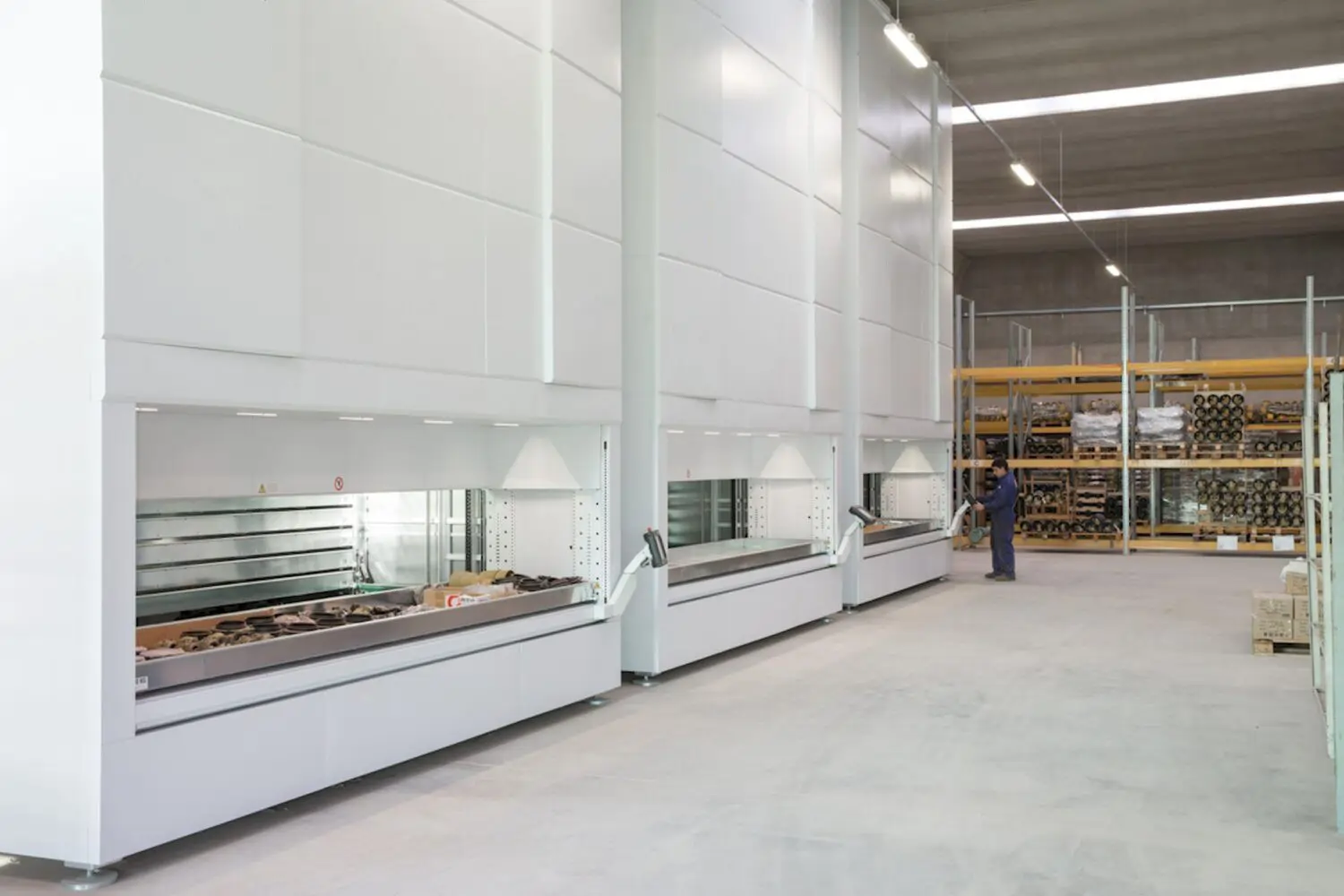
Our new article looks at how TL-1900 to TL-4100 vertical lift warehouses reclaim space once taken up by static shelving, deliver accurate picking, and provide real-time, reliable inventory data.
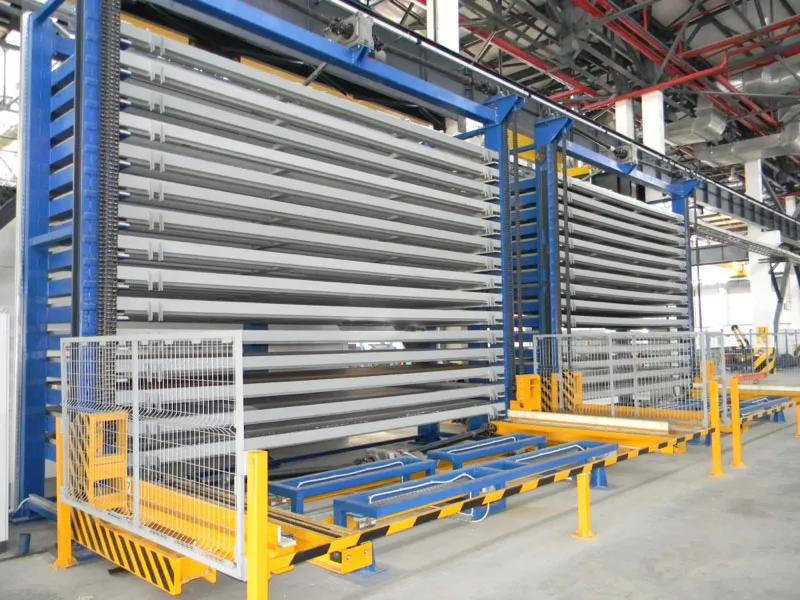
An automated metal warehouse is not only state-of-the-art equipment but also an effective tool for reducing production costs. Learn about the hidden costs of traditional metal storage, how to calculate the economic impact of automation, and why modern businesses are switching to intelligent storage systems.
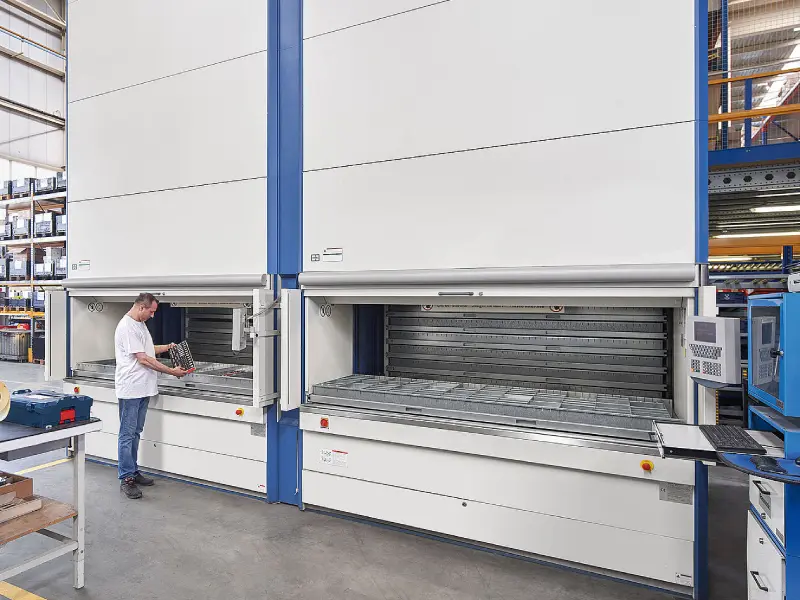
How a VLM works, what it costs, payback period. Save up to 85% of warehouse space. Turnkey manufacturing and installation.