Contents:
- What “Operational Excellence” Really Means for a Warehouse
- How a Vertical Lift Warehouse Works
- Order Instead of Chaos: How Automation Disciplines the Process
- Your People: From Walking the Floor to Skilled Work
- Space, Time, and Inventory Control
- The TL Line: Choosing the Right Model
- The Bottom Line: Where Operational Excellence Starts
- Frequently Asked Questions
What “Operational Excellence” Really Means for a Warehouse
An automated vertical lift warehouse is often seen simply as a way to save space. In practice, it changes the underlying logic of how a warehouse runs — from how a retrieval request is generated to what the storekeeper actually spends their shift doing.
Operational excellence isn’t a one-time improvement in numbers. It’s a plant’s ability to run consistently to the same quality standard, regardless of shift, operator, or workload. On the warehouse floor, that means parts are stored densely, found quickly, issued without errors, and protected from damage, dust, and unauthorized access. Automated vertical lift warehouses turn that consistency from an occasional achievement into a built-in property of the process itself.
How a Vertical Lift Warehouse Works
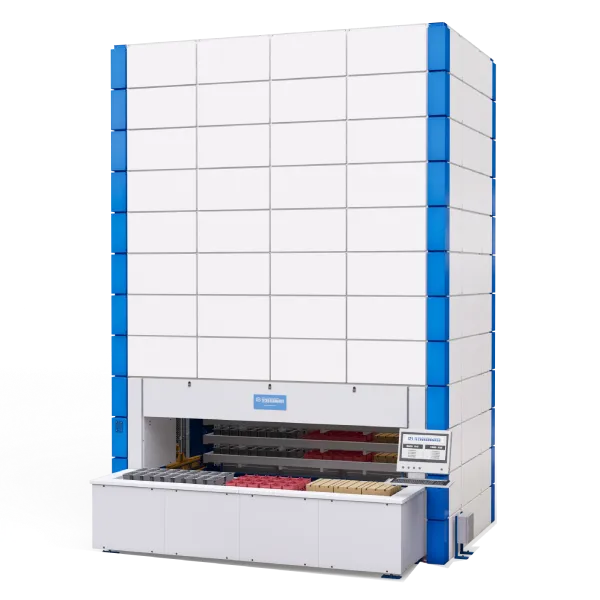
At the core of the system is a vertical lift module with trays stacked along its full height. The operator doesn’t need to climb shelving or search for a location: on request, the lift mechanism automatically locates the correct tray and delivers it to an access window at a comfortable working height. All that’s left for the operator to do is pick or place the item and confirm the transaction in the system.
Control runs on software that tracks every storage location, logs every inbound and outbound movement, and, where needed, works alongside pick-to-light technology — a light that points directly to the right compartment on the tray — along with barcode or RFID scanning. This makes it structurally difficult for an operator to grab the wrong item, even when rushed or new to the station.
Order Instead of Chaos: How Automation Disciplines the Process
On many production floors, the order of small and medium parts, tooling, and components depends on the memory of specific employees — someone knows the right part is on the third rack from the left, someone else relies on handwritten labels. The moment that person goes on leave or leaves the company, finding anything turns into trial and error.
A vertical lift warehouse removes that dependency on “the person who remembers everything.” Every item is stored in a defined location under software control, and retrieval happens on request — nobody has to search manually. The process stays the same no matter who’s standing at the delivery window.
The effect shows up most clearly in picking accuracy: where mixing up parts or tooling by size or spec used to be routine, automated retrieval all but eliminates that error, since the system physically delivers the exact tray requested. And every mispick isn’t just wasted time re-searching for the right part — it’s downtime on the next station, waiting for material that should already be there.
Your People: From Walking the Floor to Skilled Work
A large share of the working day in a traditional shelving-based warehouse doesn’t go toward productive work at all — it goes toward movement: walking to the right aisle, locating an item, sometimes climbing a ladder or using a forklift, then walking back. Industry research on warehouse logistics has found that this kind of travel and search time can account for more than half of a picker’s working day.
When a lift module takes over that job, this share of the workload disappears. One operator at a single workstation can handle a volume of items that previously required a whole team of storekeepers. The people freed up don’t need to be let go — they can be redirected to work that requires real skill: quality control, documentation, or setup of adjacent equipment.
There’s also a less obvious but important effect: workplace safety. Working at height, climbing shelving ladders, and using equipment to reach upper tiers are common sources of warehouse injuries. Automated delivery to the access window removes that burden from staff entirely.
Space, Time, and Inventory Control
Traditional shelving is one of the least efficient ways to use a facility’s floor space: aisles between racks need to be wide enough for equipment, and the upper tiers often sit half-empty simply because they’re inconvenient to reach.
A vertical lift warehouse uses the height of the building rather than its floor area: trays are stored compactly, one above another, inside a single module, and reaching any item takes seconds — whether it’s stored near the bottom or at the very top. In practice, this frees up a significant share of space previously tied up in shelving and aisles, space that can go toward an additional production line or a buffer zone instead.
The effect on inventory control matters just as much. The control software logs every movement — inbound, outbound, remaining stock — in real time, and can be integrated with the plant’s ERP system. As a result, inventory data stops being an approximation: what the system shows matches what’s physically on the shelf. That has a direct impact on purchasing decisions — replenishment orders get placed based on actual need rather than “just in case,” which reduces the amount of working capital tied up in stock.
The TL Line: Choosing the Right Model
Techvagonmash’s vertical lift warehouses come in five sizes — from TL-1900 to TL-4100 — with tray width ranging from 1900 to 4100 mm, a tray depth of 650 mm, and a permitted load height of 600 mm per tray. Tray load capacity is 500 kg for the TL-1900 through TL-3500 models, rising to 750 kg for the largest model, TL-4100, allowing a configuration to be matched to light items — fasteners, tooling, electronic components — as well as heavier parts and workpieces.
The system can be adapted to the specifics of a given production line: perforated, sectioned, or adjustable trays; compartments with dividers and tool holders; pick-to-light / put-to-light indication for an added layer of retrieval control; integration with industrial robots and barcode systems; and multi-level access control ranging from a PIN code to biometrics. For facilities with special requirements, climate-control options (temperature and humidity control) and dust- and moisture-resistant designs rated IP65 or higher are available — relevant for storing electronics, tooling, and consumables.
The Bottom Line: Where Operational Excellence Starts
Operational excellence on the production floor doesn’t come from isolated, one-off improvements — it’s built into the architecture of processes, equipment, and how work is organized. An automated vertical lift warehouse is one of the tools that changes several layers of a plant’s operations at once: process discipline, labor allocation, use of floor space, and the reliability of inventory data.
For plants handling a wide range of parts, tooling, components, or workpieces on an ongoing basis, moving to automated vertical storage is a natural next step toward a more predictable, better-controlled warehouse operation.
Frequently Asked Questions
What is a vertical lift warehouse?
It’s a storage system where trays holding parts are stacked vertically inside a single lift module, and the mechanism automatically locates the correct tray and delivers it to an access window on the operator’s request, without manual searching through shelving.
How much floor space does a TL vertical lift warehouse save compared to shelving?
By using the height of the building instead of floor area, plants typically reclaim a significant share of space previously occupied by shelving and forklift aisles. The exact figure depends on the facility’s ceiling height and the model chosen, from TL-1900 to TL-4100.
Can a vertical lift warehouse be integrated with an ERP system?
Yes, the software supports integration with ERP systems, barcode and RFID scanning, and remote cloud-based monitoring, providing accurate, real-time inventory data.
Want to find out which TL model and configuration fit your production best? Contact the Techvagonmash team for a solution tailored to your storage volumes and item range.
Related articles
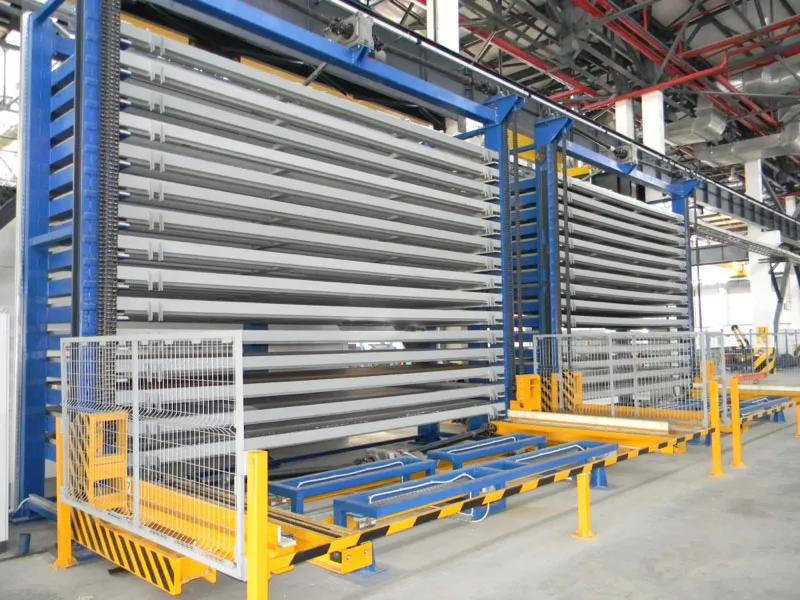
An automated metal warehouse is not only state-of-the-art equipment but also an effective tool for reducing production costs. Learn about the hidden costs of traditional metal storage, how to calculate the economic impact of automation, and why modern businesses are switching to intelligent storage systems.
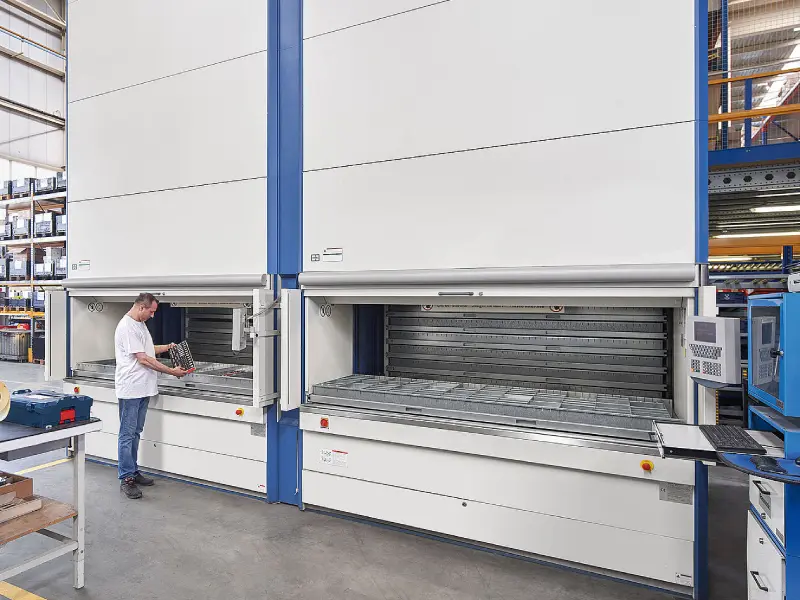
How a VLM works, what it costs, payback period. Save up to 85% of warehouse space. Turnkey manufacturing and installation.
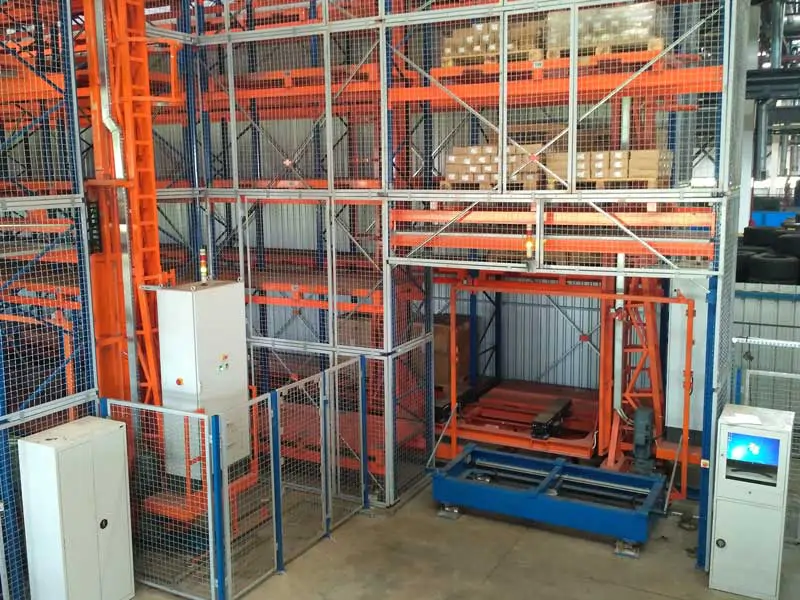
How an automated rack-type warehouse saves up to 90% of space and replaces manual material inventory with automatic inventory—details include the design, technical parameters, and application scenarios.