In short: floor storage is the cheapest way to start, but the most expensive in floor area, wasted handling time and damaged material. Cantilever racks are the practical middle ground for most warehouses handling from a few dozen tonnes a month. An automated warehouse pays off where floor space is costly, the range of items is wide and production needs accurate, scheduled retrieval. Below is a comparison by cost, footprint and typical use.
Contents
- Why the storage method affects your cost per tonne
- Floor and stack storage
- Cantilever racks
- Automated warehouse
- Comparison table
- Worked floor-area example
- How to choose
- FAQ
Why the storage method affects your cost per tonne
A steel warehouse is not just a place where metal sits. The storage method drives four cost items that rarely appear in the same spreadsheet:
- Floor area and rent. A square metre under a roof can be leased out, built on or given to production.
- Lost time. Searching for the right grade, section and length, and moving top bundles to reach the ones below.
- Damage and corrosion. Dents, bent long products, sling marks, rust from ground and moisture contact.
- Safety. Stack collapse, rolling bars and tubes, injuries during manual re-handling.
So storage methods should be compared not by equipment price, but by total cost of ownership per tonne of throughput.
Floor and stack storage
The simplest option: bundles are laid on dunnage directly on the warehouse floor or on a covered yard. It needs no capital investment and suits small volumes, heavy or slow-moving items, and yards served by an overhead crane.
What to observe
- Place steel on supports, never directly on bare floor or ground.
- Put spacers between bundles (several industrial safety rules call for at least 40 mm thick) so slings can be released and the stack stays stable.
- Limit stack height for manual stacking (some occupational-safety rules cite about 1.5 m). Above that, stack only with mechanical handling.
- Keep the stack height-to-base ratio within a stable range. Logistics guidelines commonly use no more than 3:1.
- Mark storage zones and aisles with floor lines.
Advantages
- Minimal capital cost.
- No limit on bundle length or weight.
- Suitable for seasonal and temporary stock.
Disadvantages
- Lowest storage density per square metre when stack height is limited.
- Access only to top bundles: to reach a lower one, upper ones must be moved.
- High risk of deformation and corrosion, especially in open yards.
- Stock records depend on people, not a system: errors in grade and heat number are unavoidable as the range grows.
Cantilever racks for steel
Cantilever racks are uprights with projecting arms on which long products are laid: tubes, angles, channels, beams, bars and profiles. With no front upright, a bundle of any length can be loaded and removed from the end or the side without length limits.
Where they are used
- Long-product stores handling 3–12 m lengths.
- Plants with a blanking area (saw, plasma, bending).
- Steel service centres with a wide range of sections.
Configurations
- Single-sided and double-sided: double-sided racks save floor area by sharing an aisle.
- For manual and mechanical loading: forklifts, side loaders, overhead cranes.
- For open yards: with a full roof and galvanised or protective coating.
Advantages
- Direct access to every item: no need to move neighbouring bundles.
- Higher storage density than the floor: building height is used, not just area.
- Less deformation and damage, clear sorting by grade and section.
- Modular: racks can be extended or reconfigured for a new range.
Disadvantages
- Investment in racks and suitable handling equipment (side loader or crane).
- Aisle width for handling equipment eats part of the floor-area gain.
- Search and records stay manual unless a warehouse management system is introduced.
Automated warehouse
In an automated storage and retrieval system (AS/RS), loading and retrieval are controlled by software: stacker cranes or crane-manipulators take a load from its cell on command and deliver it to an operator or a line. For metal, the options include cassette systems for long products, rack-type stores and vertical stores for sheet; sheet metal is where such solutions are most common.
Who it suits
- Plants feeding laser, plasma and press-brake machines that need exact sheets or blanks on schedule.
- Sites with no room to extend the warehouse.
- Companies with many items (grade × thickness × size) and a high cost of picking errors.
Advantages
- Highest storage density: industry sources estimate the footprint of automated stores at several times smaller than conventional solutions.
- Retrieval without manual re-handling; integration with ERP/MES and WMS.
- Less damage and fewer people in the heavy-load zone.
- Accurate real-time stock records.
Disadvantages
- Highest capital cost and the longest project lead time.
- Requirements for foundation, building height and utilities.
- Maintenance and skilled staff are needed.
The scale of investment varies widely by system type. According to open industry estimates, automated systems for pallet loads start at around one million euros, while high-bay stores for extra-heavy loads (such as steel coils) can cost an order of magnitude more. For sheet and long-product metal the price is set by the project: dimensions, cell load, number of items and level of integration, so rely on a quotation rather than a “price per cell”.
If you are considering automating sheet metal storage, see VerMet automated sheet metal storage.
Comparison table: floor, cantilever racks, automated warehouse
The values below are engineering reference points for a first estimate, not a price list. Exact figures depend on the range, bundle weight, building height and region.
| Criterion | Floor storage | Cantilever racks | Automated warehouse |
|---|---|---|---|
| Capital cost | Minimal (dunnage, floor marking) | Medium (racks + forklift/crane) | High (equipment, software, foundation, installation) |
| Floor area per 100 t | Largest (baseline) | Noticeably smaller than floor, thanks to height | Smallest: several times less than a conventional store |
| Use of height | Low (1.5–3 m depending on stacking) | Good (4–8 m and above) | Maximum (up to building height) |
| Access to an item | Top bundles only | Direct to every cell | Automatic, on command |
| Retrieval speed | Low, depends on re-handling | Medium to high | High, predictable |
| Risk of damage and corrosion | High | Low | Minimal |
| Stock records | Manual | Manual or WMS | Automatic, ERP/MES integration |
| Flexibility when range changes | High | High (racks can be reconfigured) | Limited by project parameters |
| Time to launch | Days | Weeks | Months |
| Best suited for | Small volumes, heavy one-off items | Long products, wide range, moderate to high throughput | Space shortage, costly errors, integration with production |
Worked example: floor area for 500 t of long products
Assumptions (illustrative, replace with your data): stock of 500 t; average packing density of bundles including spacers of about 3 t per m³ of stack volume; stack height 1.5 m on the floor for manual stacking and 3 m with a crane; area utilisation factor including aisles of 0.5 for the floor and 0.6 for a crane zone.
- Floor, 1.5 m stack: 3 × 1.5 = 4.5 t per m² of stack; with aisles about 2.25 t/m²; area about 220 m².
- Floor with crane, 3 m stack: 3 × 3 = 9 t/m²; with aisles about 5.4 t/m²; area about 90 m², provided an overhead crane and stable stacking are available.
- Cantilever racks: depends on rack height and aisle width for handling equipment, but compared with floor storage without a crane the area typically drops by 1.5–2.5 times with much better access to items (estimate, needs a project calculation).
- Automated warehouse: the smallest area, because aisle width is minimised and the full building height is used.
Takeaway: if you have no crane and limited building height, moving from the floor to cantilever racks gives the fastest floor-area gain. Automation saves the most space but makes sense when floor space is expensive and retrieval volume is high.
How to choose a storage method
- Assess throughput and stock. How many tonnes pass through the store per month and how much sits on average.
- Split the range. Heavy and rare items can stay on the floor, fast-moving long products go on cantilever racks, sheet for machines goes into an automated system.
- Put a price on floor space. If space can be extended cheaply, payback on racks and automation falls; if not, it rises.
- Count the losses. Time spent searching and re-handling, scrap and corrosion, machine downtime waiting for blanks.
- Check the building. Height, floor load, column grid, existing cranes.
- Plan for growth. Modular systems let you expand the store without stopping work.
In practice many plants arrive at a hybrid: cantilever racks for long blanks, automated storage for sheet and floor space for oversized exceptions.
FAQ on storing steel stock
What is the cheapest way to store steel stock?
In capital cost, floor storage. But once lost time, damage and floor-area use are counted, its total cost of ownership is often higher than racks as throughput grows.
How do cantilever racks differ from ordinary pallet racks?
Cantilever racks have no front uprights: arms project from the column, so long loads of any length can be placed freely. Pallet racks are designed for pallets and limited by bay size.
Can steel be stored in an open yard?
Yes, but with protection from rain and ground contact: supports or racks, a roof and, where needed, preservation. Long-term outdoor storage of galvanised and thin-wall products is not recommended.
When does an automated metal warehouse pay back?
When floor space is scarce or expensive, the range is wide and machines need predictable material feed. Payback depends on project cost, floor-space value and losses from manual re-handling, so it is calculated for each plant.
How do I calculate the floor area of a steel store?
Determine the stock in tonnes, packing density, storage height and the area utilisation factor including aisles and equipment zones. For rack and automated systems, area is set by the project.
Need a calculation for your range and building? Send a request: Techvagonmash engineers will propose a storage option and estimate floor area and budget.
Related articles
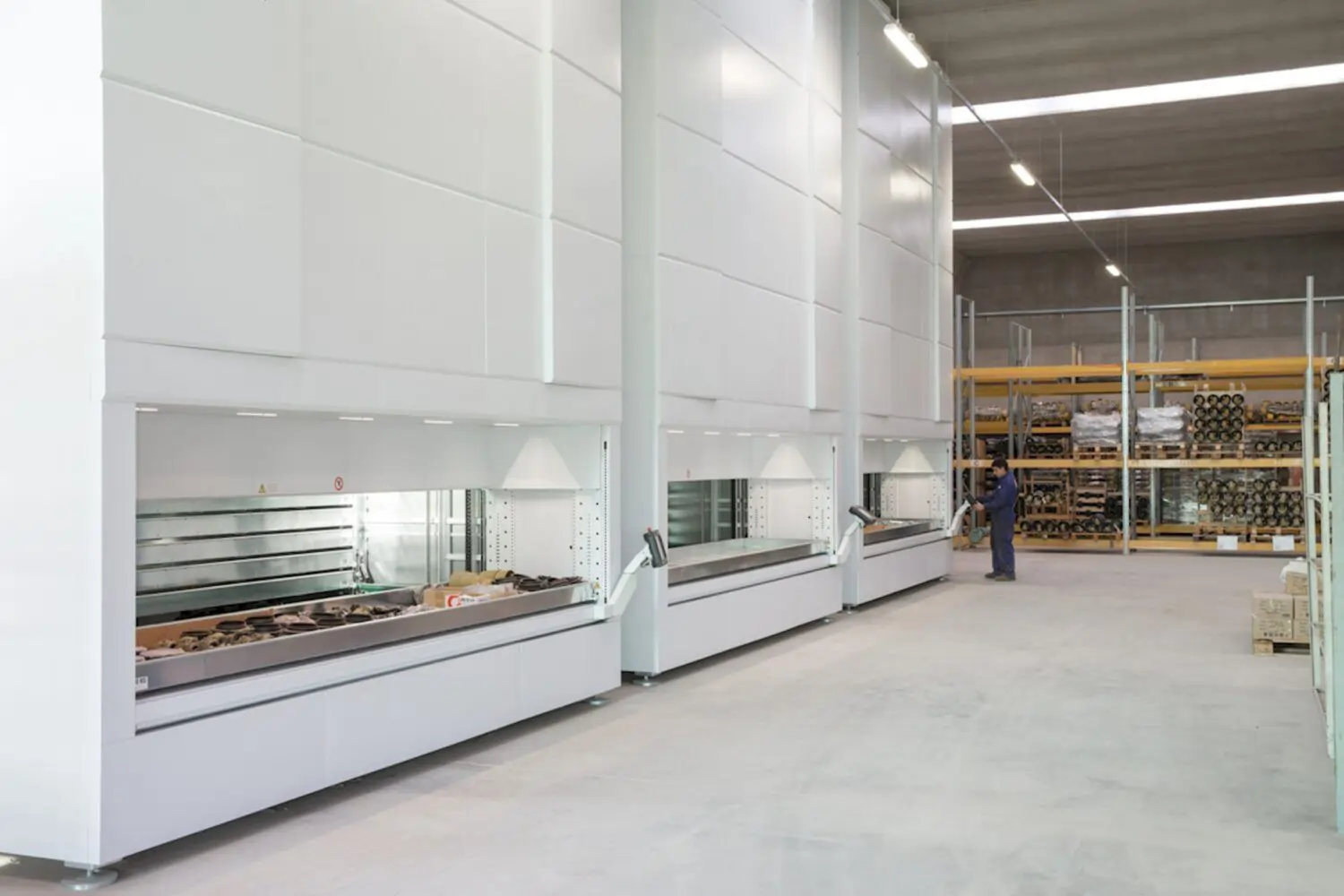
Our new article looks at how TL-1900 to TL-4100 vertical lift warehouses reclaim space once taken up by static shelving, deliver accurate picking, and provide real-time, reliable inventory data.
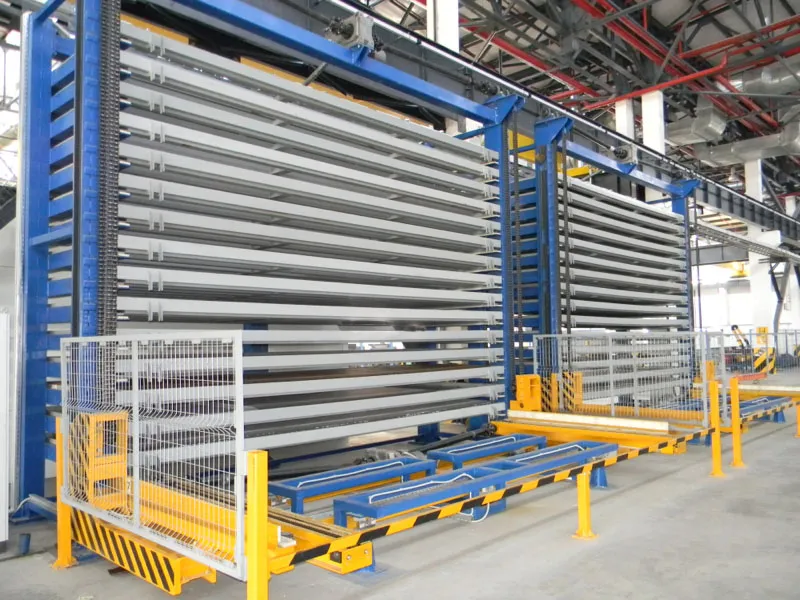
An automated metal warehouse is not only state-of-the-art equipment but also an effective tool for reducing production costs. Learn about the hidden costs of traditional metal storage, how to calculate the economic impact of automation, and why modern businesses are switching to intelligent storage systems.
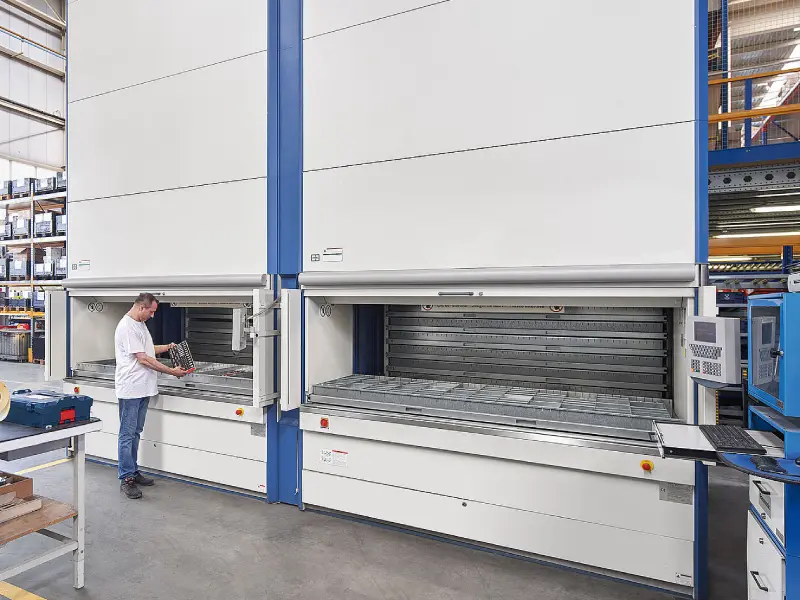
How a VLM works, what it costs, payback period. Save up to 85% of warehouse space. Turnkey manufacturing and installation.
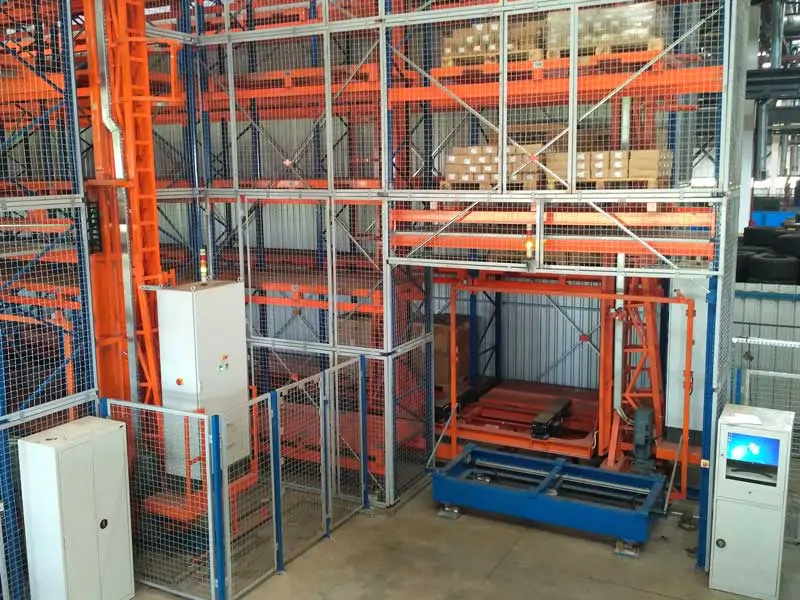
How an automated rack-type warehouse saves up to 90% of space and replaces manual material inventory with automatic inventory—details include the design, technical parameters, and application scenarios.