A traversers (also called a transfer table) is rail-mounted equipment used for the linear and parallel movement of rolling stock — railcars, locomotives, diesel locomotives, or loaded trolleys — from one track to another within the confined space of a workshop, depot, or production site. A traverser replaces a section of railway switches where there isn’t room to build one, letting a single platform serve several parallel tracks.
Contents:
- How a Traverser Works
- Main Components of a Traverser
- Technical Specifications: Real Model Examples
- Control System and Operating Modes
- Traverser Safety Systems
- Traverser vs. Turntable
- Installation and Commissioning
- Where Traverser Are Used
- Frequently Asked Questions
How a Traverser Works
A traverser is a platform (base frame) mounted on its own running wheels that moves along rails laid perpendicular to the main tracks of a workshop. Short sections of rail track are installed on the platform. Rolling stock rolls onto the traverser, the platform travels along its guide rails to the target track, and stops so that the platform’s rails align with the receiving track’s rails — after which the rolling stock can roll off.
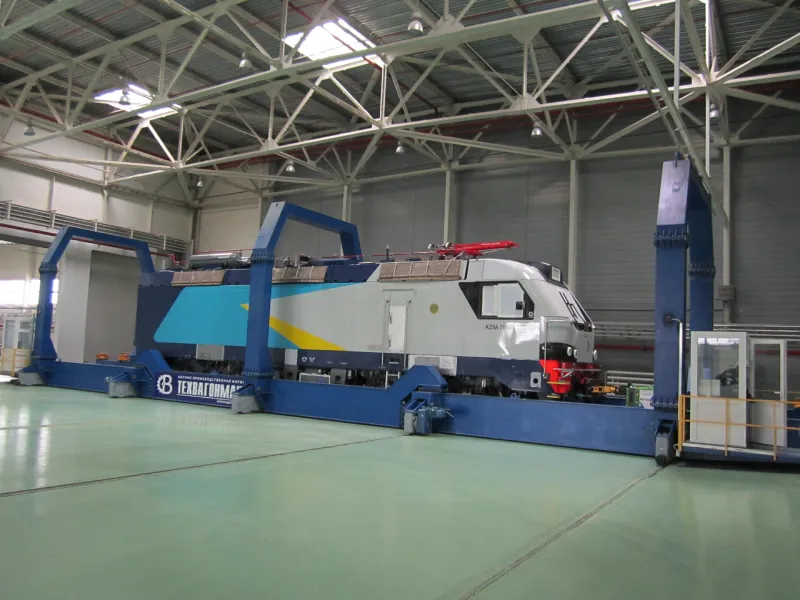
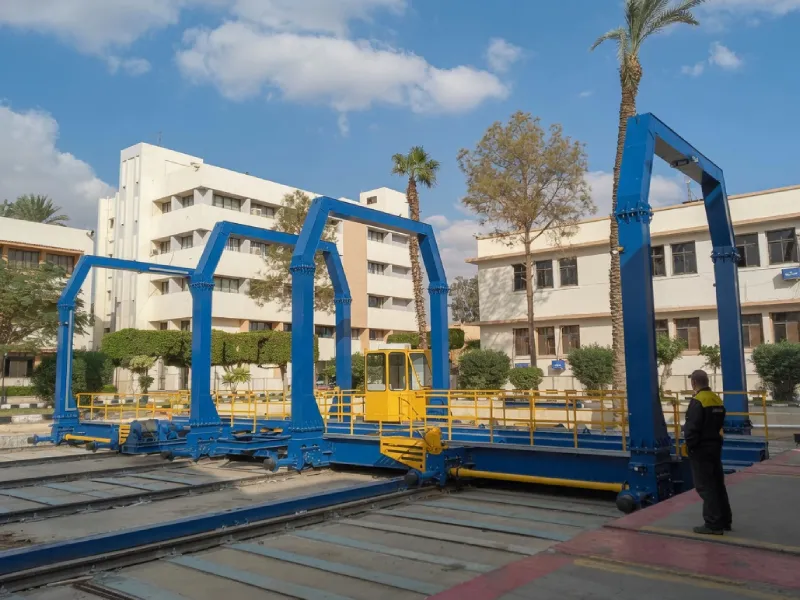
Platform movement is provided by gear motors on the drive bogies, while movement of the railcar or locomotive across the platform itself is handled by a traction winch: a cable, routed through a double idler block, hooks onto the frame of the unit being moved and pulls it onto or off the traverser. Drive motor speed is smoothly regulated by frequency converters, providing precise acceleration and braking without jerks.
Main Components of a Traverser
Regardless of load capacity, a traversers design includes several core components:
- Base frame (platform) — a frame made of structural steel sections, mounted on several supports with running wheels; rails for moving rolling stock are fixed between the frame’s load-bearing beams.
- Idler and drive bogies — wheel sets fitted with dust-protected roller bearings; the drive bogies carry compact motors with a built-in electromagnetic brake and a flat gearbox, whose output shaft connects directly to the running wheel axle.
- Power arches (portals) — structures made of plate and structural steel that increase platform rigidity and absorb loads from the rolling stock.
- Traction winch with a rope layer — moves the railcar or locomotive across the traverser platform through a system of idler blocks.
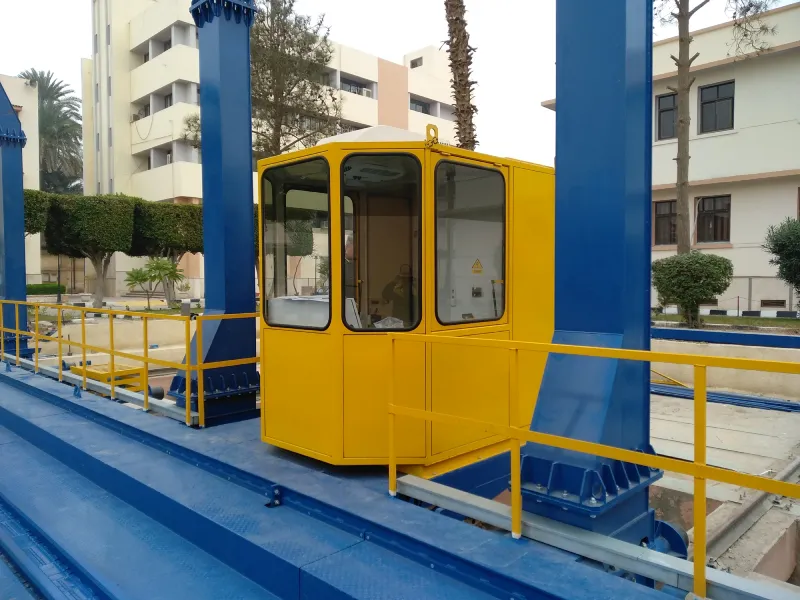
- Operator cabin — built from plate and structural steel, fitted with shatterproof glass windows, lighting, and air conditioning.
- Ramp (apron) — on models without a recessed pit: a movable and a fixed frame linked by hinges and springs; as a wheel rolls onto the traverser it forms an inclined section connecting the approach track to the platform.
- Electrical equipment — a control cabinet, control panel(s), pushbutton stations, position and safety sensors, cabling, and a conductor rail system supplying power to the moving platform.
Technical Specifications: Real Model Examples
Traverser parameters are always engineered for a specific task — track gauge, load capacity of the rolling stock, and the customer’s track layout.
Control System and Operating Modes
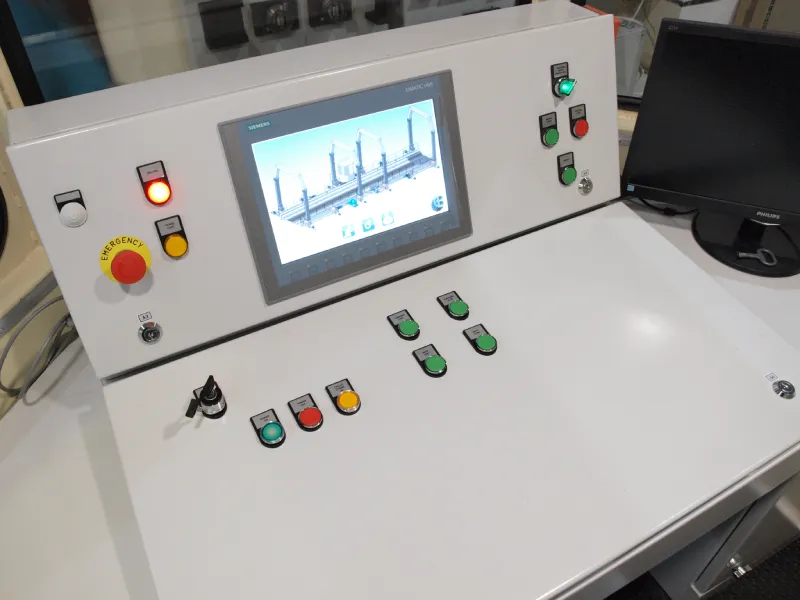
The control system of a modern traverser is built around a programmable logic controller (PLC) — for example, a Siemens — and includes a control cabinet, a control panel with an operator interface, pushbutton stations, and position sensors. Drive motor speed is regulated by frequency converters, providing smooth acceleration and braking of both the platform and the winch.
For precise positioning and synchronization of the travel mechanisms, a traverser is fitted with a linear position sensor; on several models, platform location is read from a barcode strip laid along the travel path.
A traverser can operate in two modes:
- Manual mode — used briefly during commissioning and repair work; some safety interlocks are disabled in this mode.
- Semi-automatic mode — the primary mode for regular operation, with all working interlocks active.
The operator panel on the control desk displays a start screen, a setup menu, a service menu, a fault message log, and a working screen showing the traverser’s current position.
Traverser Safety Systems
A traverser is high-hazard equipment, so its design includes several independent protection circuits:
- Laser scanners (anti-collision device) — monitor the space ahead of the traverser during movement; when an obstacle is detected, the platform slows down and sounds an audible signal in the operator cabin, and if the obstacle isn’t cleared, movement is fully blocked.
- Emergency stop buttons — mounted on all corners of the platform on the outside, as well as on the control panel and stationary pushbutton stations; standard mushroom-head buttons in red on a yellow background.
- Audible and visual signaling — a warning bell on the traverser structure and in the operator cabin, plus four yellow flashing beacons at the platform’s corners during movement.
- Safety interlocks — monitored by the PLC, they cut power to the drives if the working cycle is disrupted, a limit switch trips, or the safety signal is lost.
- Video surveillance — used to visually correct the traverser’s position relative to the approach tracks and to monitor movement in both directions; a video recorder can be added as an option.
Traverser vs. Turntable
Traverser and turntables solve a similar task — redistributing rolling stock between tracks — but in different ways. A turntable rotates a railcar or locomotive in place around a vertical axis, which suits a fan-shaped depot track layout. A traverser moves rolling stock linearly, in a transverse direction, without rotation — a solution suited to the parallel track layouts typical of workshop and factory floor plans.
Installation and Commissioning
A traverser is delivered to the customer partially disassembled and installed on the customer’s existing foundations. The typical installation sequence is:
- De-preservation of parts and assemblies protected with grease for transport (grease removal with wooden scrapers, followed by solvent cleaning).
- Installing wheel beams on the foundation rails, then mounting the cross beams.
- Fastening the platform sections and welding the rails on top of the sections.
- Installing the platform for the operator cabin.
- Installing the power arches, the winch with its platform, equalizing blocks, and the remaining components.
- Installing the electrical equipment and the power conductor rail system.
Before initial start-up, the completeness and correctness of assembly are checked, along with the tightness of bolted connections, whether mechanism movements match the commands issued, and the oil level in the drive gearboxes.
Where Traversers Are Used
Traversers are used at facilities with a network of parallel rail tracks:
- locomotive and railcar depots;
- metallurgical plants — for moving ingots, billets, and rolling stock between workshop bays;
- machine-building and railcar-building enterprises;
- facilities that service and repair diesel locomotives and locomotives.
Techvagonmash designs and manufactures traversers to the customer’s technical specification, matched to their production conditions, track layout, and rolling stock — technical parameters and equipment cost are agreed individually for each project.
Frequently Asked Questions
What is the difference between a traverser and a turntable?
A turntable rotates a railcar around a vertical axis; a traverser moves rolling stock horizontally onto a parallel track without rotation.
What load capacity do Techvagonmash traversers have?
From 40 to 150 tons and above — the exact parameter is engineered individually for the customer’s track layout and rolling stock.
How is a traverser protected against collisions and emergencies?
Laser scanners stop movement when an obstacle is detected, emergency stop buttons are placed around the platform perimeter, and audible/visual signaling plus PLC-controlled safety interlocks are in place.
What operating modes does a traverser support?
Manual mode for commissioning and repair work, and semi-automatic mode for regular operation with the full set of interlocks active.