In structural steel and railway wagon manufacturing, a large share of the time goes not into welding itself but into turning the workpiece so the welder can reach the joint. A beam has to be slung, lifted by a crane, flipped and re-aligned, often several times per cycle. A chain beam rotator solves this differently: the workpiece stays at one station and is turned at the push of a button. Below we look at the benefits this brings to production and what to check when choosing equipment.
Contents
- What a chain beam rotator is and how it works
- 8 key benefits
- Payback: counting the minutes
- What can be turned
- Techvagonmash BeamMaster chain beam rotators: models and specifications
- What to look for when choosing
- FAQ
- Conclusion
What a chain beam rotator is and how it works
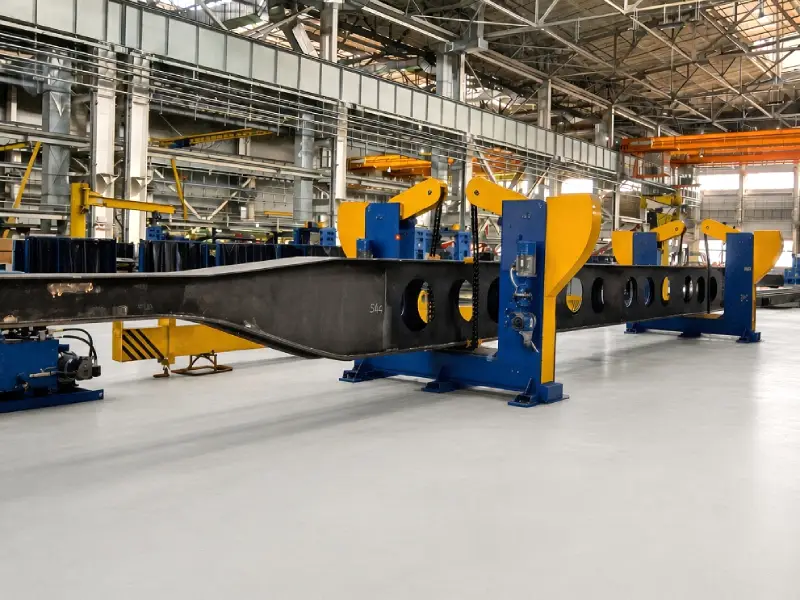
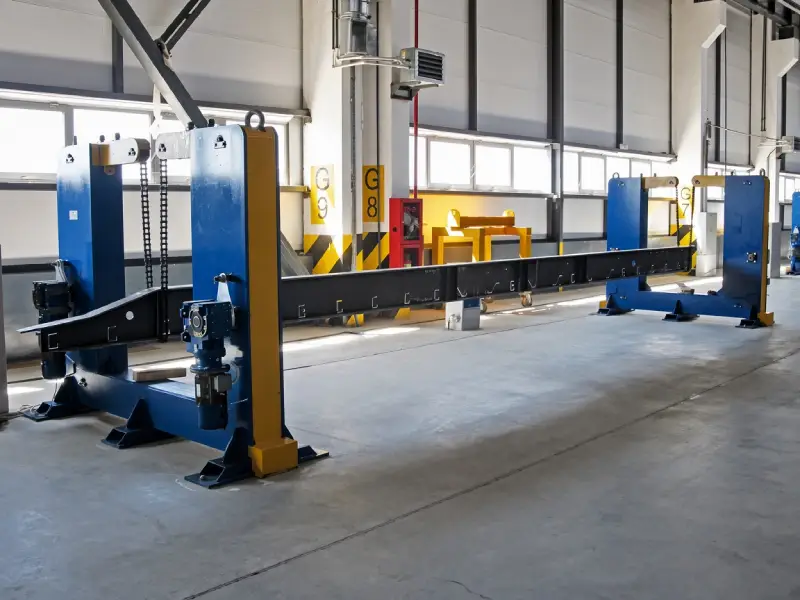
A chain beam rotator (also called a rotator turning device) consists of two stands placed at the required distance from each other. Each stand carries a drive chain: the workpiece rests on the chains, and both stands turn it in sync about its longitudinal axis. Full 360° rotation is possible in both directions.
Key design elements:
- Synchronized drive. The motors of both stands work in step, so a long beam is not twisted during rotation.
- Heavy-duty chain. The chain carries the weight of the workpiece, including asymmetric and complex profiles.
- Gripping arms. In some designs they open and close under the weight of the workpiece: the arms close as it is lowered in and open as it is lifted out, so loading needs no extra steps.
- Handheld pendant. The operator sets the direction and speed of rotation and, on some models, the working height.
- Movable stands. The spacing is adjusted to the workpiece length using a forklift, a crane or, on lighter models, a hand pallet truck.
8 key benefits of chain beam rotators
1. Substantial time savings
According to manufacturers, even experienced welders and fitters spend about five minutes turning a single beam safely with a crane, and final fit-up and welding typically require 4–5 turns. That adds up to roughly 20 minutes of pure handling per part, and the more complex the part, the longer it takes. A rotator completes a turn in under a minute, and manufacturers estimate the overall gain in working time at 30–40%. For BeamMaster rotators made by Techvagonmash, we see productivity gains of 25–40% on serial batches compared with manual turning by crane.
2. Independence from the shop crane
The crane is one of the busiest resources in any shop. Every time it is occupied flipping a beam, other operations stop and the welder waits in line. With a rotator the crane is needed only for loading and unloading, and in many cases a forklift can do even that. The workpiece can be turned at any moment without waiting for the crane to become free.
3. Operator safety
Manual turning with slings is a high-risk zone: the load can swing, a sling can slip, and people stand close to a suspended workpiece. A rotator holds the part on its chains and turns it in a controlled way while the operator works at a safe distance from the pendant. This lowers the risk of injury and makes it easier to meet occupational safety requirements.
4. Better weld quality
When the workpiece can be turned at any moment so that the joint lies in a convenient position, for example flat, the welder works with more confidence and consistency. Every area of the workpiece is accessible without repositioning, which means fewer defects caused by awkward positions and less rework.
5. Ergonomics and welder health
Welding in awkward postures is a common cause of back pain and early fatigue. A rotator lets the welder work in a comfortable position, and adjustable working height fits the workpiece to the welder. Experienced specialists stay productive for longer, which is especially valuable when skilled labor is scarce.
6. Versatility
A rotator is not tied to one workpiece size. The spacing between the stands is adjustable, so the same equipment handles both short and very long parts. On BeamMaster rotators the base between the drive units is set anywhere from 1,500 to 12,000 mm, and some foreign models allow a stand spacing of up to 15 m. A long part is supported at as many points as it needs, and several fitters and welders can work on it at the same time.
7. Compact footprint
Two stands with chains take noticeably less floor space than traditional welding stands and positioners. For shops where growth is limited by floor area, this is a strong argument: output rises without a layout change.
8. Integration with lines and automation
A rotator can be built into a beam welding line or combined with a welding robot: the workpiece is turned to the required position and the robot makes the weld. The electrical side matters for welding too: in some designs the return cable (ground) is connected through the chain, which simplifies the welding circuit.
Payback: counting the minutes
The effect of a rotator is easy to estimate with your own data. Below is an illustrative calculation based on the industry estimates above; substitute the figures for your own shop.
| Indicator | Turning by crane | Chain beam rotator |
|---|---|---|
| Time per turn | up to ~5 min | under 1 min |
| Turns per workpiece | 4–5 | 4–5 |
| Turning time per workpiece | ~20 min | ~4–5 min |
| Saving on 20 workpieces per shift | about 5 hours of working time | |
On top of this come less visible but real savings: a freed-up crane, fewer weld defects, fewer injuries and sick days, and welders who spend their time welding instead of waiting.
What can be turned
- I-beams, channels and welded beams;
- crane girders and other long steel structures;
- welded frames and box structures;
- pipes and pipe blanks;
- rails;
- heat exchangers and other large equipment.
The main industries are steel construction, railway wagon and general machine building, shipbuilding, and the production of welded assemblies in serial and one-off manufacturing.
Techvagonmash BeamMaster chain beam rotators: models and specifications
Techvagonmash designs and manufactures chain rotators for positioning I-beams and T-beams during welding, fit-up and surface treatment. The endless chain drive turns profiles up to 12,000 mm long clockwise and counterclockwise through any angle, and the shop crane is needed only for loading and unloading. Three standard models cover the most common beam sizes.
| # | Index | Model | ||
| BeamMaster-600 | BeamMaster-1000 | BeamMaster-1500 | ||
| 1. | Overall dimensions of handling workpiece, mm | |||
| Width, mm | 600 | 1000 | 1500 | |
| Height, mm | 600 | 1000 | 1500 | |
| Length (min), mm | 1500-12000 | |||
| 2. | Rotation Speed, RPM | 1,5 | 1,5 | 1,2 |
| 3. | Rotating drive | сhain | ||
| 4. | Installed capacity, Kw | 12 | 16 | 18 |
| 5. | Overall dimensions of the rotator, mm | |||
| Length | 10000 | 10000 | 10200 | |
| Width | 2200 | 2620 | 3100 | |
| Height | 2500 | 2990 | 3400 | |
| 6. | Weight, kg | 3000 | 3470 | 5000 |
What production gets
- Reversing and smooth speed control. The beam can be brought precisely to the required position according to the welding procedure.
- Variable base. The spacing between the drive units is set to the workpiece length from 1,500 to 12,000 mm.
- Built-in grounding. The chain loop keeps the ground contact during rotation, which is especially important in automated welding.
- Welding in a convenient position. Flat and horizontal welding on all four faces of the beam gives uniform penetration and reduces the risk of defects typical of overhead and vertical welding.
- Non-standard sections. The chain loop adapts to the profile shape, so asymmetric and built-up sections can be handled.
What they are used for
BeamMaster rotators work with welded I-beams and T-beams, box and built-up beam structures, channels, closed rectangular profiles and long frame assemblies for wagons, overhead cranes and industrial frames. In practice, the BeamMaster-600 is used, for example, to turn side members and beams, and the BeamMaster-1000 to position center sills during welding and riveting. Typical industries: freight and passenger wagon building, crane manufacturing, bridge building, heavy engineering and metallurgy.
Non-standard versions and service
- Special versions are developed to a technical specification for non-standard sections, longer lengths or integration into automated welding lines. A technical and commercial proposal based on your workpiece drawing is prepared within 5 working days.
- Supervised installation, commissioning and operator training are carried out at sites in Ukraine and abroad; training is included in the equipment price.
- The warranty is up to 24 months, followed by service and post-warranty support including spare parts supply. Maintenance comes down to regular lubrication and checking fasteners and controls.
More about the model range: chain rotator for welding I-beams and T-beams.
What to look for when choosing a chain beam rotator
- Load capacity. BeamMaster models are rated for 6, 12 and 15 t; compare them with the maximum weight of your workpiece, with a margin and including fixtures.
- Turning envelope. The workpiece section, including protruding elements, must fit within 600 × 600, 1,000 × 1,000 or 1,500 × 1,500 mm for the BeamMaster-600, BeamMaster-1000 and BeamMaster-1500 respectively.
- Chain and drive reliability. A dual-link chain and a powerful synchronized drive matter for complex and asymmetric profiles.
- Stand spacing adjustment. Check how it is done (forklift, crane, pallet truck) and what maximum spacing is possible.
- Loading method. Ease of loading by crane and forklift, and self-opening arms.
- Control system. A handheld pendant with a clear interface and smooth speed control.
- Welding current return. The ability to route the return cable through the chain.
- Service and support. Local service, spare parts and operator training.
FAQ
What is a chain beam rotator?
It is a pair of synchronized stands with drive chains that hold a beam or welded structure and turn it about its longitudinal axis through 360° without a crane. The operator controls the rotation from a handheld pendant.
What parts can be turned on a chain beam rotator?
I-beams and channels, welded box and frame structures, crane girders, pipes, rails, sheet metal packs, heat exchangers and other long workpieces. The limits are set by the load capacity and the turning envelope of the specific model.
How much does a chain beam rotator reduce welding time?
Manufacturers of comparable equipment claim that turning time falls from several minutes (with a crane or forklift) to under a minute, and estimate the overall saving in working time at 30–40%. The actual effect depends on the product mix, the number of turns and shop organization.
Which chain beam rotator models does Techvagonmash make?
Three standard models: BeamMaster-600 (up to 6,000 kg, workpiece section up to 600 × 600 mm), BeamMaster-1000 (up to 12,000 kg, up to 1,000 × 1,000 mm) and BeamMaster-1500 (up to 15,000 kg, up to 1,500 × 1,500 mm). Workpiece length ranges from 1,500 to 12,000 mm. Non-standard versions are available to a technical specification.
What warranty and service come with Techvagonmash chain beam rotators?
The equipment carries a warranty of up to 24 months. Techvagonmash provides supervised installation, commissioning, operator training (included in the equipment price), and service and post-warranty support with spare parts supply.
Is a crane needed to operate a beam rotator?
A crane or forklift is needed only to load and unload the workpiece. All turns during fit-up and welding are performed by the rotator itself, so the crane does not stand idle waiting and stays free for other work in the shop.
Conclusion
A chain beam rotator is not just a “turntable for beams”. It solves several production problems at once: it cuts handling time, frees the crane, improves safety, makes welders’ work easier and weld quality better, and takes up little space. The more repeated turns your process involves, the faster the equipment pays for itself.
Techvagonmash makes the BeamMaster-600, BeamMaster-1000 and BeamMaster-1500 chain beam rotators with load capacities from 6 to 15 t for beams up to 12 m long, and develops special versions for non-standard sections and automated lines. To calculate the economic effect for your shop, send us a drawing of your workpiece and we will prepare a technical and commercial proposal within 5 working days.
Related articles
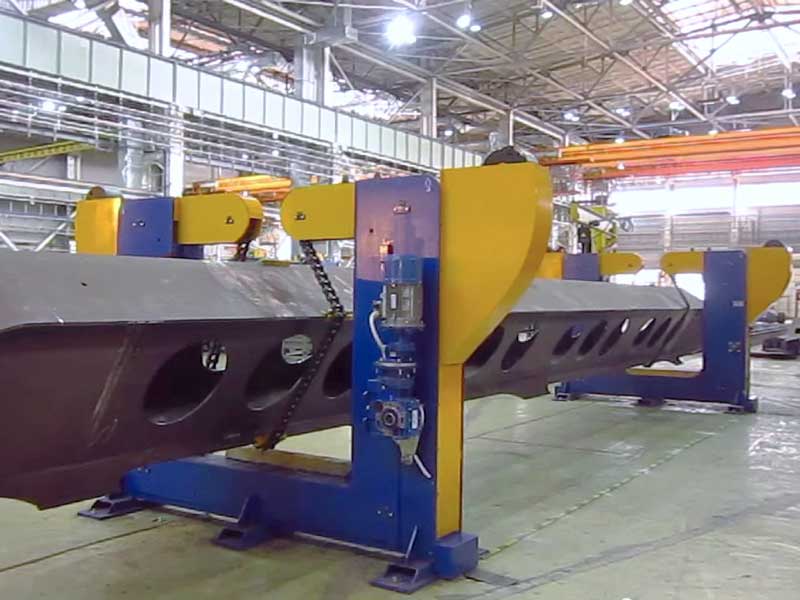
Chain beam rotators help automate the welding process of heavy metal structures, reduce production time, and improve the quality of welded joints. Learn how using modern equipment can reduce production costs, improve work safety, and increase welding efficiency.
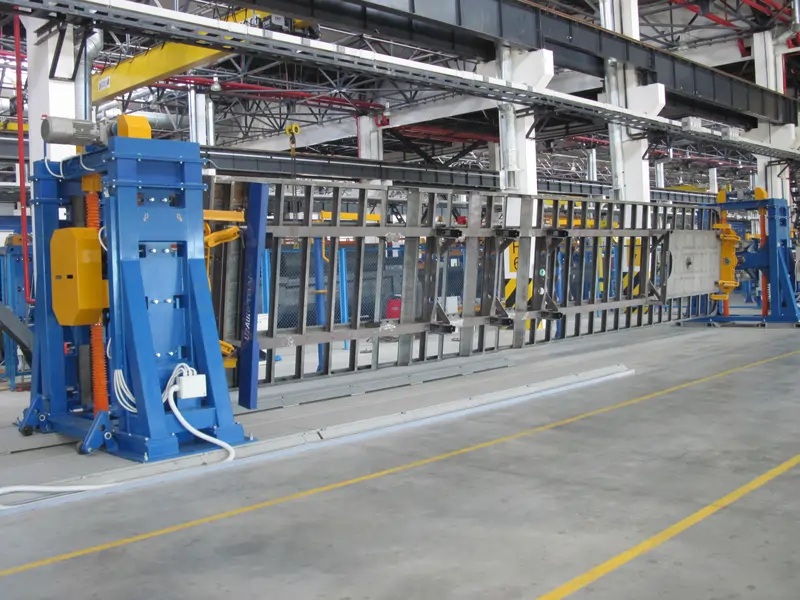
This article discusses the main advantages of using positioners when welding.